

Positive Aspects of Valid Dumps MD-102 Exam Dumps! [Oct-2024]
First Attempt Guaranteed Success in MD-102 Exam 2024
Microsoft MD-102 Exam Syllabus Topics:
| Topic | Details |
|---|---|
| Topic 1 |
|
| Topic 2 |
|
| Topic 3 |
|
| Topic 4 |
|
NEW QUESTION # 56
You have a computer named Computed that has Windows 10 installed.
You create a Windows PowerShell script named config.psl.
You need to ensure that config.psl runs after feature updates are installed on Computer5.
Which file should you modify on Computer5?
- A. Unattend.xml
- B. LiteTouch.wsf
- C. Unattendb*
- D. SetupConfig.ini
Answer: D
Explanation:
SetupConfig.ini is a file that can be used to customize the behavior of Windows Setup during feature updates.
You can use this file to specify commands or scripts that run before or after the installation process. To run a PowerShell script after a feature update, you can use the PostOOBE parameter in SetupConfig.ini and specify the path to the script file. References: [SetupConfig.ini reference]
NEW QUESTION # 57
You use Microsoft Intune and Intune Data Warehouse.
You need to create a device inventory report that includes the data stored in the data warehouse.
What should you use to create the report?
- A. Endpoint analytics
- B. the Company Portal app
- C. the Azure portal app
- D. Microsoft Power Bl
Answer: D
Explanation:
You can use the Power BI Compliance app to load interactive, dynamically generated reports for your Intune tenant. Additionally, you can load your tenant data in Power BI using the OData link. Intune provides connection settings to your tenant so that you can view the following sample reports and charts related to:
Devices
Enrollment
App protection policy
Compliance policy
Device configuration profiles
Software updates
Device inventory logs
Note: Load the data in Power BI using the OData link
With a client authenticated to Azure AD, the OData URL connects to the RESTful endpoint in the Data Warehouse API that exposes the data model to your reporting client. Follow these instructions to use Power BI Desktop to connect and create your own reports.
Sign in to the Microsoft Endpoint Manager admin center.
Select Reports > Intune Data warehouse > Data warehouse.
Retrieve the custom feed URL from the reporting blade, for example:
https://fef.{yourtenant}.manage.microsoft.com/ReportingService/DataWarehouseFEService/dates?api-version=v1.0 Open Power BI Desktop.
Choose File > Get Data. Select OData feed.
Choose Basic.
Type or paste the OData URL into the URL box.
Select OK.
If you have not authenticated to Azure AD for your tenant from the Power BI desktop client, type your credentials. To gain access to your data, you must authorize with Azure Active Directory (Azure AD) using OAuth 2.0.
Select Organizational account.
Type your username and password.
Select Sign In.
Select Connect.
Select Load.
NEW QUESTION # 58
You have an Azure AD tenant named contoso.com that contains the devices shown in the following table.
The tenant contains the Azure AD groups shown in the following table.
You add an Autopilot deployment profile as shown in the following exhibit.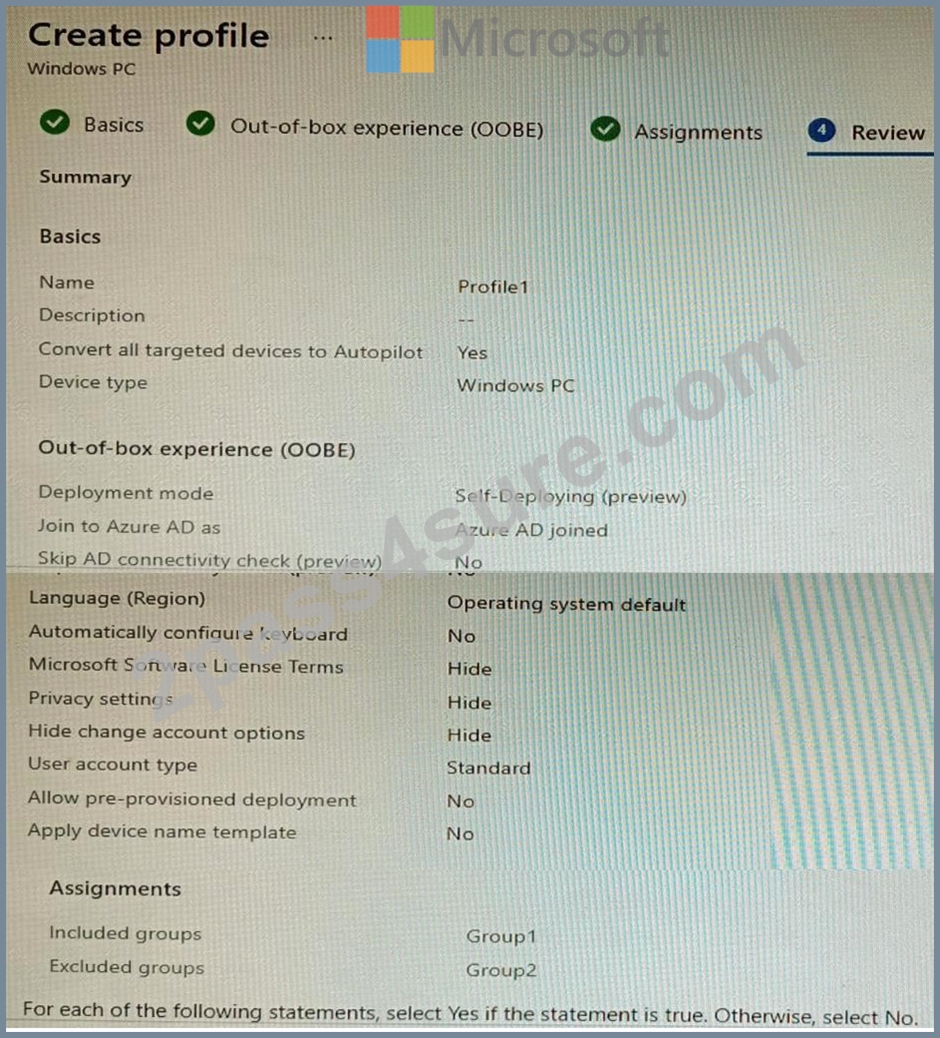
You have an Azure AD tenant named contoso.com that contains the devices shown in the following table.
The tenant contains the Azure AD groups shown in the following table.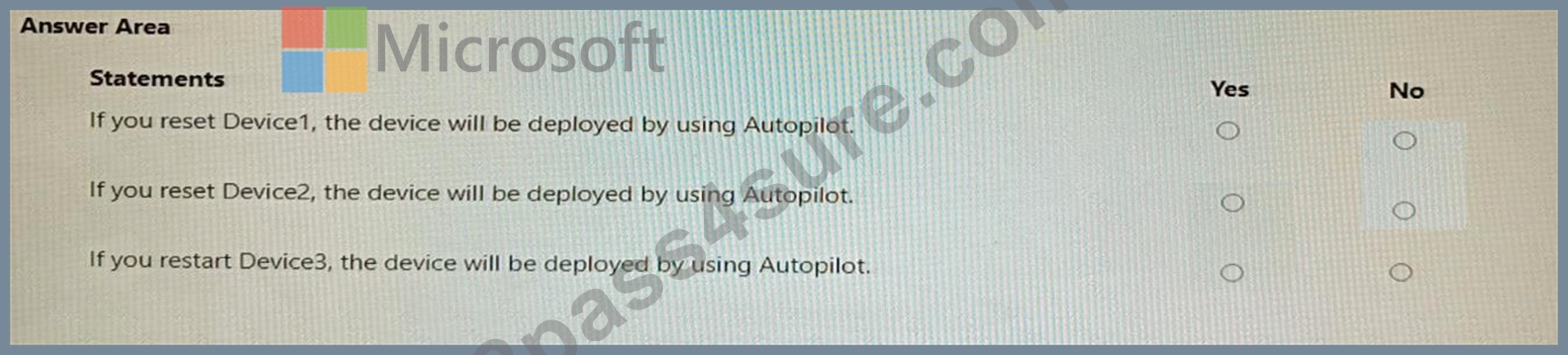
Answer:
Explanation:
Explanation: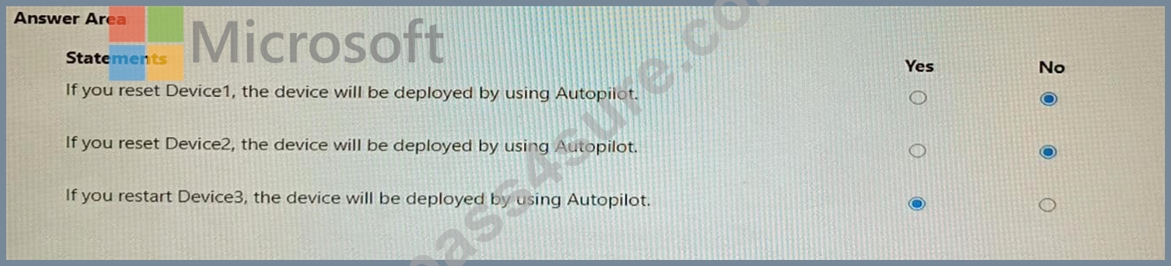
NEW QUESTION # 59
You have a Microsoft 365 E5 subscription that contains the devices shown in the following table.
All devices have Microsoft Edge installed.
From the Microsoft Intune admin center, you create a Microsoft
You need to apply Edge1 to all the supported devices.
To which devices should you apply Edge1?
- A. Device1 only
- B. Device1, Device2, and Device4 only
- C. Device1, Device2, Device3, and Device4
- D. Device1 and Device2 only
- E. Device1, Device2, and Device3 only
Answer: C
NEW QUESTION # 60
You have a Microsoft 365 subscription that uses Microsoft Intune Suite.
You use Microsoft Intune to manage devices. All devices are in the same time zone.
You create an update rings policy and assign the policy to all Windows devices.
On the November 1, you pause the update rings policy.
All devices remain online.
Without further modification to the policy, on which date will the devices next attempt to update?
- A. November 22
- B. December 6
- C. November 15
- D. December 1
Answer: C
NEW QUESTION # 61
You have an Azure Active Directory (Azure AD) tenant that contains the users shown in the following table.
You have devices enrolled in Microsoft Intune as shown in the following table.
From Intune, you create and send a custom notification named Notification1 to Group1.
For each of the following statements, select Yes if the statement is true. Otherwise, select No.
NOTE: Each correct selection is worth one point.
Answer:
Explanation:
Explanation
A screenshot of a computer Description automatically generated with medium confidence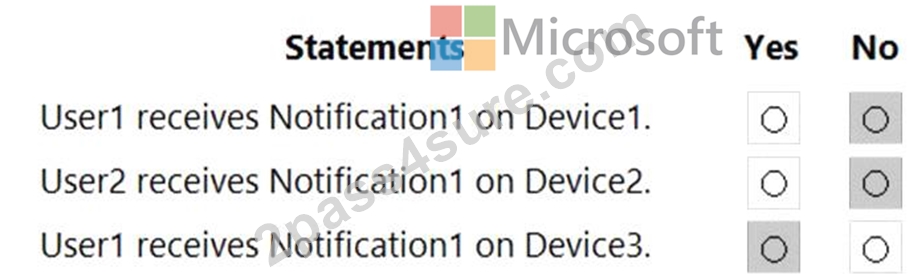
Reference:
https://docs.microsoft.com/en-us/mem/intune/remote-actions/custom-notifications
NEW QUESTION # 62
You have a Microsoft 365 subscription.
You use Microsoft Intune Suite to manage devices.
You have the iOS app protection policy shown in the following exhibit.
Use the drop-down menus to select the answer choice that completes each statement based on the information presented in the graphic. NOTE: Each correct selection is worth one point,
Answer:
Explanation: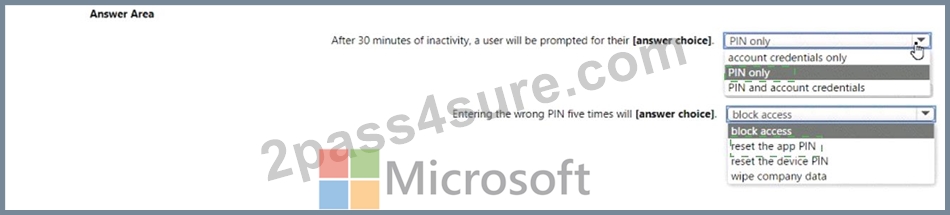
Explanation:
Box 1 = PIN only
Box 2 = reset the PIN app
iOS/iPadOS app protection policy settings - Microsoft Intune | Microsoft Learn
https://learn.microsoft.com/en-us/mem/intune/apps/app-protection-policy-settings-ios
NEW QUESTION # 63
You have an Azure AD tenant named contoso.com.
You plan to use Windows Autopilot to configure the Windows 10 devices shown in the following table.
Which devices can be configured by using Windows Autopilot self-deploying mode?
- A. Device 1, Device2, and Device3
- B. Device2 only
- C. Device2 and Devnce3 only
- D. Device3 only
Answer: D
Explanation:
Windows Autopilot self-deploying mode requires devices that have a firmware-embedded activation key for Windows 10 Pro or Windows 11 Pro. This feature allows devices to automatically activate Windows Enterprise edition using the subscription license assigned to the user. Device1 does not have a firmware-embedded activation key, so it cannot use self-deploying mode. Device2 and Device3 have firmware-embedded activation keys for Windows 10 Pro, so they can use self-deploying mode. References: Windows Autopilot self-deploying mode (Public Preview), Deploy Windows Enterprise licenses
NEW QUESTION # 64
You have a Microsoft 365 subscription that uses Microsoft Intune Suite.
You use Microsoft Intune to manage devices.
You plan to create Windows 11 device builds for the marketing and research departments The solution must meet the following requirements:
* Marketing department devices must support Windows Update for Business.
* Research department devices must have support for feature update versions for up to 36 months from release.
What is the minimum Windows 11 edition required for each department? To answer, select the appropriate options in the answer area.
NOTE: Each correct selection is worth one point
Answer:
Explanation:
Explanation
NEW QUESTION # 65
You have a Microsoft 365 E5 subscription. All devices are enrolled in Microsoft Intune.
You create a Conditional Access policy named Policy! that requires multifactor authentication (MFA).
You need to ensure that Policy1 only applies to devices marked as noncompliant. Which settings of Policy1 should you configure?
- A. Target resources
- B. Device platforms under Conditions
- C. Grant
- D. Filter for devices under Conditions
- E. Session
Answer: D
NEW QUESTION # 66
You are evaluating which devices are compliant.
For each of the following statements, select Yes if the statement is true. Otherwise, select No.
NOTE: Each correct selection is worth one point.
Answer:
Explanation:
Explanation:
NEW QUESTION # 67
You have SOO Windows 10 devices enrolled in Microsoft Intune.
You plan to use Exploit protection in Microsoft Intune to enable the following system settings on the devices:
* Data Execution Prevention (DEP)
* Force randomization for images (Mandatory ASlR)
You need to configure a Windows 10 device that will be used to create a template file.
Which protection areas on the device should you configure in the Windows Security app before you create the template file? To answer, drag the appropriate protection areas to the correct settings. Each protection area may be used once, more than once, or not at all. You may need to drag the split bar between panes or scroll to view content.
NOTE: Each correct selection is worth one point.
Answer:
Explanation:
Explanation:
Exploit protection is a feature that helps protect against malware that uses exploits to infect devices and spread. Exploit protection consists of many mitigations that can be applied to either the operating system or individual apps1.
To configure a Windows 10 device that will be used to create a template file for Exploit protection, you need to configure the following protection areas on the device in the Windows Security app:
* DEP: Device security. Data Execution Prevention (DEP) is a mitigation that prevents code from running in memory regions marked as non-executable. You can enable DEP system-wide or for specific apps in the Device security section of the Windows Security app1.
* Mandatory ASLR: App & browser control. Force randomization for images (Mandatory ASLR) is a mitigation that randomizes the location of executable images in memory, making it harder for attackers to predict where to inject code. You can enable Mandatory ASLR system-wide or for specific apps in the App & browser control section of the Windows Security app1.
NEW QUESTION # 68
You have a Microsoft 365 subscription that contains 1,000 iOS devices. The devices are enrolled in Microsoft Intune as follows:
* Two hundred devices are enrolled by using the Intune Company Portal.
* Eight hundred devices are enrolled by using Apple Automated Device Enrollment (ADE).
You create an iOS/iPadOS software updates policy named Policy 1 that is configured to install iOS/iPadOS 15.5.
How many iOS devices will Policy1 update, and what should you configure to ensure that only iOS/iPadOS 15.5 is installed? To answer, select the appropriate options in the answer area.
NOTE: Each correct selection is worth one point.
Answer:
Explanation:
NEW QUESTION # 69
For each of the following statements, select Yes if the statement is true. Otherwise, select No.
NOTE: Each correct selection is worth one point.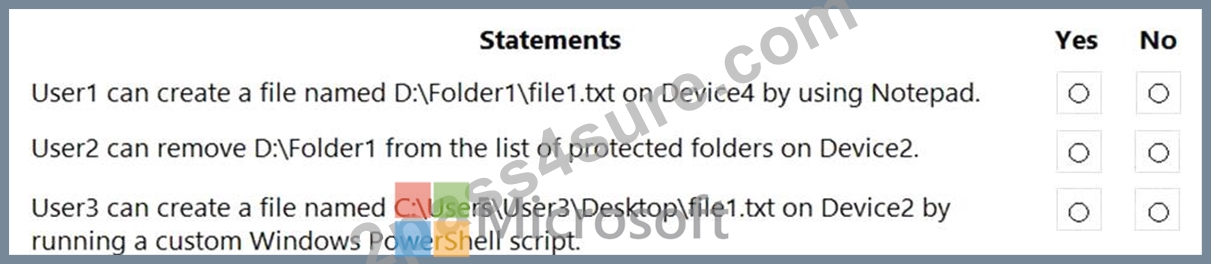
Answer:
Explanation: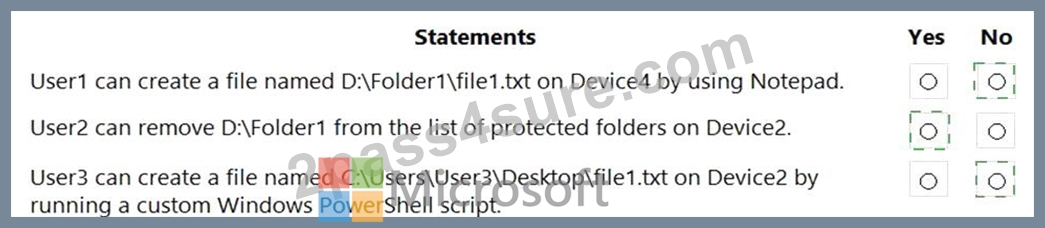
Explanation
A screenshot of a computer Description automatically generated with medium confidence
Topic 2, Litware inc
This is a case study. Case studies are not timed separately. You can use as much exam time as you would like to complete each case. However, there may be additional case studies and sections on this exam. You must manage your time to ensure that you are able to complete all questions included on this exam in the time provided.
To answer the questions included in a case study, you will need to reference information that is provided in the case study. Case studies might contain exhibits and other resources that provide more information about the scenario that is described in the case study. Each question is independent of the other questions in this case study.
At the end of this case study, a review screen will appear. This screen allows you to review your answers and to make changes before you move to the next section of the exam. After you begin a new section, you cannot return to this section.
To start the case study
To display the first question in this case study, click the button. Use the buttons in the left pane to explore the content of the case study before you answer the questions. Clicking these buttons displays information such as business requirements, existing environment, and problem statements. When you are ready to answer a question, click the Existing Environment Current Business Model The Los Angeles office has 500 developers. The developers work flexible hours ranging from 11:00 to 22:00.
Litware has a Microsoft System Center 2012 R2 Configuration Manager deployment. During discovery, the company discovers a process where users are emailing bank account information of its customers to internal and external recipients.
Current Environment
The network contains an Active Directory domain that is synced to Microsoft Azure Active Directory (Azure AD). The functional level of the forest and the domain is Windows Server 2012 R2. All domain controllers run Windows Server 2012 R2.
Litware has the computers shown in the following table.
The development department uses projects in Azure DevOps to build applications.
Most of the employees in the sales department are contractors. Each contractor is assigned a computer that runs Windows 10. At the end of each contract, the computer is assigned to different contractor. Currently, the computers are re-provisioned manually by the IT department.
Problem Statements
Litware identifies the following issues on the network:
Employees in the Los Angeles office report slow Internet performance when updates are downloading.
The employees also report that the updates frequently consume considerable resources when they are installed. The Update settings are configured as shown in the Updates exhibit. (Click the Updates button.) Management suspects that the source code for the proprietary applications in Azure DevOps in being shared externally.
Re-provisioning the sales department computers is too time consuming.
Requirements
Business Goals
Litware plans to transition to co-management for all the company-owned Windows 10 computers. Whenever possible, Litware wants to minimize hardware and software costs.
Device Management Requirements
Litware identifies the following device management requirements:
Prevent the sales department employees from forwarding email that contains bank account information.
Ensure that Microsoft Edge Favorites are accessible from all computers to which the developers sign in.
Prevent employees in the research department from copying patented information from trusted applications to untrusted applications.
Technical Requirements
Litware identifies the following technical requirements for the planned deployment:
Re-provision the sales department computers by using Windows AutoPilot.
Ensure that the projects in Azure DevOps can be accessed from the corporate network only.
Ensure that users can sign in to the Azure AD-joined computers by using a PIN. The PIN must expire every 30 days.
Ensure that the company name and logo appears during the Out of Box Experience (OOBE) when using Windows AutoPilot.
Exhibits
NEW QUESTION # 70
You have a Microsoft 365 subscription.
All users have Microsoft 365 apps deployed.
You need to configure Microsoft 365 apps to meet the following requirements:
* Enable the automatic installation of WebView2 Runtime.
* Prevent users from submitting feedback.
Which two settings should you configure in the Microsoft 365 Apps admin center? To answer, select the appropriate settings in the answer area.
NOTE: Each correct selection is worth one point.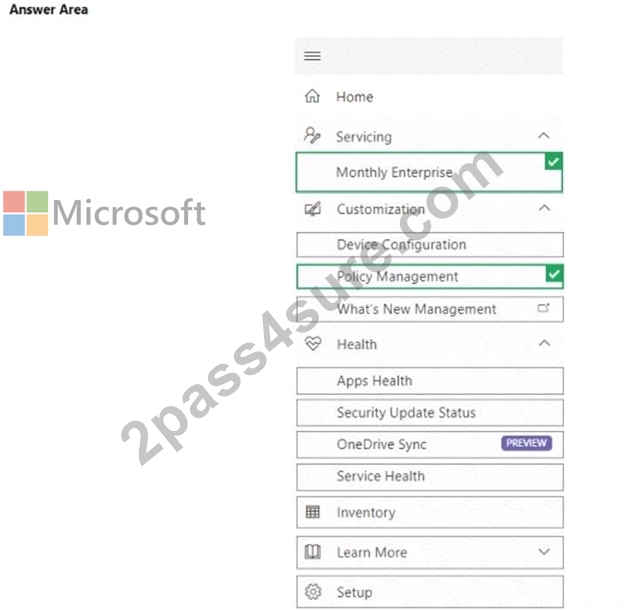
Answer:
Explanation:
Explanation
D:\mudassar\Untitled.jpg
NEW QUESTION # 71
You have the MDM Security Baseline profile shown in the MDM exhibit. (Click the MDM tab.) You have the ASR Endpoint Security profile shown in the ASR exhibit. (Click the ASR tab.)

You plan to deploy both profiles to devices enrolled in Microsoft Intune. You need to identify how the following settings will be configured on the devices:
* Block Office applications from creating executable content
* Block Win32 API calls from Office macro
Currently, the settings are disabled locally on each device.
What are the effective settings on the devices? To answer, select the appropriate options in the answer area.
NOTE: Each correct selection is worth one point.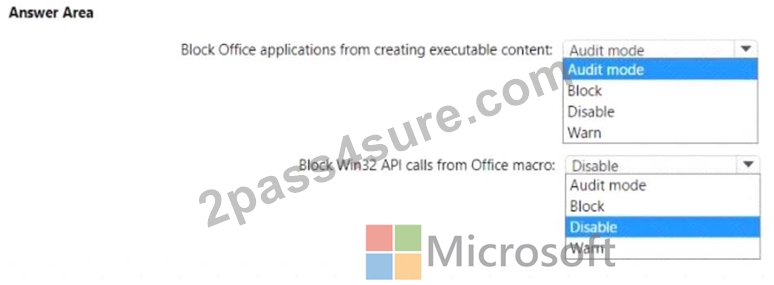
Answer:
Explanation: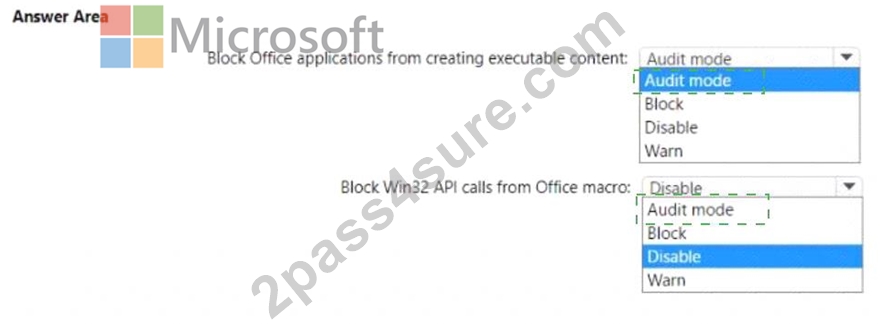
Explanation:
lock Office App from creating executable content: Audit Mode
Both are set to Audit so that's what it will do.
Block Win32 API calls from the Office Macro: Audit
If you set the Baseline policy as Disable or Not Configured (same thing), and you have any other setting in the ASR, the ASR configuration will take over. That's how enterprise environments enforce granular controls of policies that are enforced for a smaller subset of the employee population. The article below (Jan 27, 2024) outlines the scenario and provides comments about this. In theory this also makes sense. If the baseline policy is configured to do nothing, and the ASR policy is configured to Audit, Block or Warn, I should think the ASR policy setting will take over the configuration.
NEW QUESTION # 72
Your company has a computer named Computer1 that runs Windows 10.
Computed was used by a user who left the company.
You plan to repurpose Computer1 and assign the computer to a new user.
You need to redeploy Computer1 by using Windows Autopilot.
Which three actions should you perform in sequence? To answer, move the appropriate actions from the list of actions to the answer area and arrange them in the correct order.
Answer:
Explanation:
Explanation
To redeploy Computer1 by using Windows Autopilot, you need to perform the following three actions in sequence:
Generate a JSON file that contains the computer information. This file specifies the Autopilot profile to be applied during the deployment. You can use the Get-AutopilotProfilesForExistingDevices PowerShell script to generate this file1.
Reset the computer. You can use the Windows Automatic Redeployment feature to trigger a reset from the login screen by pressing Ctrl + R and providing an administrator account2. Alternatively, you can use the Windows Autopilot Reset feature to remotely reset the device from Intune1.
Upload the file by running azcopy.exe. This step copies the JSON file to a blob storage account in Azure, where it can be accessed by the device during the deployment. You need to specify the storage account name, access key, and container name as parameters for azcopy.exe1.
NEW QUESTION # 73
You have a Microsoft Deployment Toolkit (MDT) server named MDT1.
When computers start from the LiteTouchPE_x64.lso image and connect to MDT1. the welcome screen appears as shown In the following exhibit.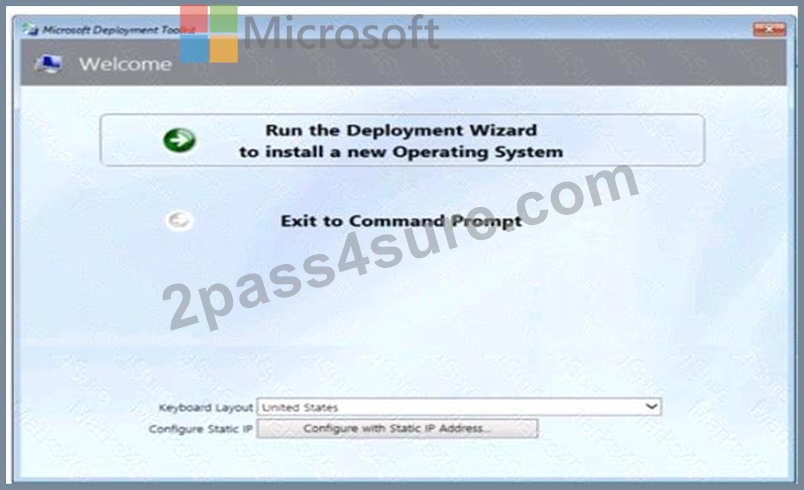
You need to prevent the welcome screen from appearing when the computers connect to MDT1.
Which three actions should you perform in sequence? To answer move the appropriate actions from the list of actions to the answer area and arrange them in the correct order.
Answer:
Explanation:
Explanation:
Box 1: Modify the Bootstrap.ini file.
Add this to your bootstrap.ini file and then update the deployment share and use the new boot media created in that process:
SkipBDDWelcome=YES
Box 2: Modify the CustomSettings.ini file.
SkipBDDWelcome
Indicates whether the Welcome to Windows Deployment wizard page is skipped.
For this property to function properly it must be configured in both CustomSettings.ini and BootStrap.ini.
BootStrap.ini is processed before a deployment share (which contains CustomSettings.ini) has been selected.
Box 3: Update the deployment share.
Reference:https://docs.microsoft.com/en-us/mem/configmgr/mdt/toolkit-reference#table-6-deployment-wizard-p
NEW QUESTION # 74
You have a Microsoft 365 subscription that includes Microsoft Intune. The subscription contains corporate-owned, fully managed Android Enterprise devices.
You plan to deploy a configuration profile that will have a device restrictions profile type named Profile1.
Profile1 will assign maintenance windows for system updates.
What should you configure from the Configuration settings for Profile1?
- A. Connectivity
- B. Power Settings
- C. Device experience
- D. General
Answer: C
NEW QUESTION # 75
You have a Microsoft 365 ES subscription that uses Microsoft Intune.
Devices are enrolled in Intune as shown in the following table.
The devices are the members of groups as shown in the following table.
You create an JOS/iPadOS update profile as shown in the following exhibit.
For each of the following statements, select Yes if the statement is true. Otherwise, select No.
NOTE: Each correct selection is worth one point.
Answer:
Explanation:
NEW QUESTION # 76
Your network contains an Active Directory domain. The domain contains 1.000 computers that run Windows
11.
You need to configure the Remote Desktop settings of all the computers. The solution must meet the following requirements:
* Prevent the sharing of clipboard contents.
* Ensure that users authenticate by using Network Level Authentication (NLA).
Which two nodes of the Group Policy Management Editor should you use? To answer, select the appropriate nodes in the answer area. NOTE: Each correct selection is worth one point.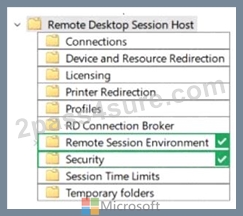
Answer:
Explanation:
Explanation
NEW QUESTION # 77
You have a Microsoft 365 subscription that contains two security groups named Group1 and Group2.
Microsoft 365 uses Microsoft Intune Suite.
You use Microsoft Intune to manage devices.
You need to assign roles in Intune to meet the following requirements:
* The members of Group1 must manage Intune roles and assignments.
* The members of Group2 must assign existing apps and policies to users and devices.
The solution must follow the principle of least privilege.
Which role should you assign to each group? To answer, select the appropriate options in the answer area.
NOTE: Each correct selection is worth one point.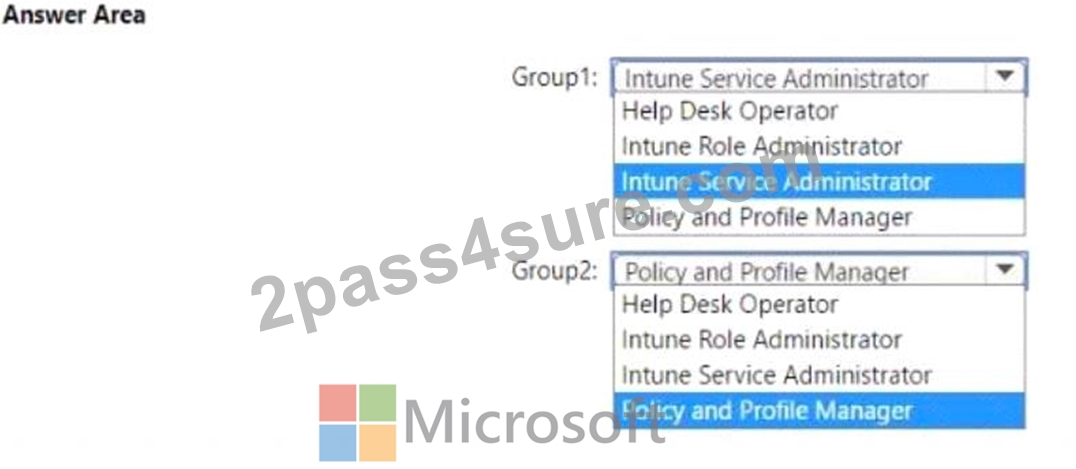
Answer:
Explanation: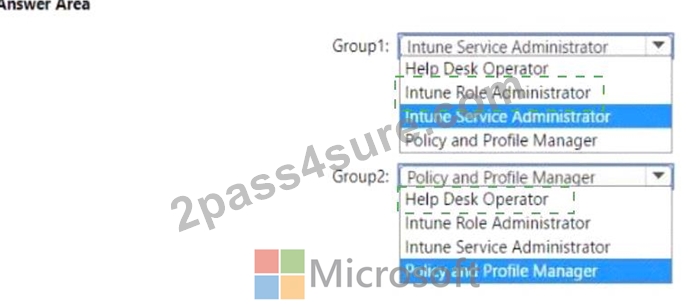
Explanation:
To assign roles in Intune to meet the requirements, you should assign the following roles to each group:
Group1: Intune Role Administrator Group2: Help Desk Operator
* The Intune Role Administrator role is the only Intune role that can manage custom Intune roles and add assignments for built-in Intune roles1. This role meets the requirement for Group1 to manage Intune roles and assignments.
* The Help Desk Operator role can perform remote tasks on users and devices, and can assign applications or policies to users or devices1. This role meets the requirement for Group2 to assign existing apps and policies to users and devices.
NEW QUESTION # 78
You have a Microsoft 365 E5 subscription that contains 10 Android Enterprise devices. Each device has a corporate-owned work profile and is enrolled in Microsoft Intune.
You need to configure the devices to run a single app in kiosk mode.
Which Configuration settings should you modify in the device restrictions profile?
- A. System security
- B. Users and Accounts
- C. Device experience
- D. General
Answer: C
Explanation:
To configure the devices to run a single app in kiosk mode, you need to modify the Device experience settings in the device restrictions profile. You can specify the app package name and activity name for the app that you want to run in kiosk mode. Reference: https://docs.microsoft.com/en-us/mem/intune/configuration/device-restrictions-android-for-work#device-experience
NEW QUESTION # 79
......
Practice LATEST MD-102 Exam Updated 304 Questions: https://certtree.2pass4sure.com/Microsoft-365-Certified/MD-102-actual-exam-braindumps.html