

Free Associate-Developer-Apache-Spark-3.5 Exam Braindumps - New 2025 Databricks Pratice Exam
Practice Test for Associate-Developer-Apache-Spark-3.5 Certification Real 2025 Mock Exam
NEW QUESTION # 22
How can a Spark developer ensure optimal resource utilization when running Spark jobs in Local Mode for testing?
Options:
- A. Increase the number of local threads based on the number of CPU cores.
- B. Set the spark.executor.memory property to a large value.
- C. Configure the application to run in cluster mode instead of local mode.
- D. Use the spark.dynamicAllocation.enabled property to scale resources dynamically.
Answer: A
Explanation:
When running in local mode (e.g., local[4]), the number inside the brackets defines how many threads Spark will use.
Using local[*] ensures Spark uses all available CPU cores for parallelism.
Example:
spark-submit --masterlocal[*]
Dynamic allocation and executor memory apply to cluster-based deployments, not local mode.
Reference:Spark Master URLs
NEW QUESTION # 23
Given a CSV file with the content:
And the following code:
from pyspark.sql.types import *
schema = StructType([
StructField("name", StringType()),
StructField("age", IntegerType())
])
spark.read.schema(schema).csv(path).collect()
What is the resulting output?
- A. [Row(name='alladin', age=20)]
- B. [Row(name='bambi', age=None), Row(name='alladin', age=20)]
- C. [Row(name='bambi'), Row(name='alladin', age=20)]
- D. The code throws an error due to a schema mismatch.
Answer: B
Explanation:
Comprehensive and Detailed Explanation From Exact Extract:
In Spark, when a CSV row does not match the provided schema, Spark does not raise an error by default.
Instead, it returnsnullfor fields that cannot be parsed correctly.
In the first row,"hello"cannot be cast to Integer for theagefield # Spark setsage=None In the second row,"20"is a valid integer #age=20 So the output will be:
[Row(name='bambi', age=None), Row(name='alladin', age=20)]
Final Answer: C
NEW QUESTION # 24
A data engineer noticed improved performance after upgrading from Spark 3.0 to Spark 3.5. The engineer found that Adaptive Query Execution (AQE) was enabled.
Which operation is AQE implementing to improve performance?
- A. Collecting persistent table statistics and storing them in the metastore for future use
- B. Optimizing the layout of Delta files on disk
- C. Improving the performance of single-stage Spark jobs
- D. Dynamically switching join strategies
Answer: D
Explanation:
Comprehensive and Detailed Explanation:
Adaptive Query Execution (AQE) is a Spark 3.x feature that dynamically optimizes query plans at runtime.
One of its core features is:
Dynamically switching join strategies (e.g., from sort-merge to broadcast) based on runtime statistics.
Other AQE capabilities include:
Coalescing shuffle partitions
Skew join handling
Option A is correct.
Option B refers to statistics collection, which is not AQE's primary function.
Option C is too broad and not AQE-specific.
Option D refers to Delta Lake optimizations, unrelated to AQE.
Final Answer: A
NEW QUESTION # 25
An engineer notices a significant increase in the job execution time during the execution of a Spark job. After some investigation, the engineer decides to check the logs produced by the Executors.
How should the engineer retrieve the Executor logs to diagnose performance issues in the Spark application?
- A. Locate the executor logs on the Spark master node, typically under the/tmpdirectory.
- B. Fetch the logs by running a Spark job with thespark-sqlCLI tool.
- C. Use the commandspark-submitwith the-verboseflag to print the logs to the console.
- D. Use the Spark UI to select the stage and view the executor logs directly from the stages tab.
Answer: D
Explanation:
Comprehensive and Detailed Explanation From Exact Extract:
The Spark UI is the standard and most effective way to inspect executor logs, task time, input size, and shuffles.
From the Databricks documentation:
"You can monitor job execution via the Spark Web UI. It includes detailed logs and metrics, including task- level execution time, shuffle reads/writes, and executor memory usage."
(Source: Databricks Spark Monitoring Guide) Option A is incorrect: logs are not guaranteed to be in/tmp, especially in cloud environments.
B).-verbosehelps during job submission but doesn't give detailed executor logs.
D).spark-sqlis a CLI tool for running queries, not for inspecting logs.
Hence, the correct method is using the Spark UI # Stages tab # Executor logs.
NEW QUESTION # 26
A developer wants to refactor some older Spark code to leverage built-in functions introduced in Spark 3.5.0.
The existing code performs array manipulations manually. Which of the following code snippets utilizes new built-in functions in Spark 3.5.0 for array operations?
A)
B)
C)
D)
- A. result_df = prices_df \
.agg(F.count_if(F.col("spot_price") >= F.lit(min_price))) - B. result_df = prices_df \
.agg(F.count("spot_price").alias("spot_price")) \
.filter(F.col("spot_price") > F.lit("min_price")) - C. result_df = prices_df \
.agg(F.min("spot_price"), F.max("spot_price")) - D. result_df = prices_df \
.withColumn("valid_price", F.when(F.col("spot_price") > F.lit(min_price), 1).otherwise(0))
Answer: A
Explanation:
Comprehensive and Detailed Explanation From Exact Extract:
The correct answer isBbecause it uses the new function count_if, introduced in Spark 3.5.0, which simplifies conditional counting within aggregations.
* F.count_if(condition) counts the number of rows that meet the specified boolean condition.
* In this example, it directly counts how many times spot_price >= min_price evaluates to true, replacing the older verbose combination of when/otherwise and filtering or summing.
Official Spark 3.5.0 documentation notes the addition of count_if to simplify this kind of logic:
"Added count_if aggregate function to count only the rows where a boolean condition holds (SPARK-
43773)."
Why other options are incorrect or outdated:
* Auses a legacy-style method of adding a flag column (when().otherwise()), which is verbose compared to count_if.
* Cperforms a simple min/max aggregation-useful but unrelated to conditional array operations or the updated functionality.
* Dincorrectly applies .filter() after .agg() which will cause an error, and misuses string "min_price" rather than the variable.
Therefore,Bis the only option leveraging new functionality from Spark 3.5.0 correctly and efficiently.
NEW QUESTION # 27
A data engineer is working on the DataFrame:
(Referring to the table image: it has columnsId,Name,count, andtimestamp.) Which code fragment should the engineer use to extract the unique values in theNamecolumn into an alphabetically ordered list?
- A. df.select("Name").distinct().orderBy(df["Name"])
- B. df.select("Name").distinct()
- C. df.select("Name").orderBy(df["Name"].asc())
- D. df.select("Name").distinct().orderBy(df["Name"].desc())
Answer: A
Explanation:
Comprehensive and Detailed Explanation From Exact Extract:
To extract unique values from a column and sort them alphabetically:
distinct()is required to remove duplicate values.
orderBy()is needed to sort the results alphabetically (ascending by default).
Correct code:
df.select("Name").distinct().orderBy(df["Name"])
This is directly aligned with standard DataFrame API usage in PySpark, as documented in the official Databricks Spark APIs. Option A is incorrect because it may not remove duplicates. Option C omits sorting.
Option D sorts in descending order, which doesn't meet the requirement for alphabetical (ascending) order.
NEW QUESTION # 28
A developer is running Spark SQL queries and notices underutilization of resources. Executors are idle, and the number of tasks per stage is low.
What should the developer do to improve cluster utilization?
- A. Reduce the value of spark.sql.shuffle.partitions
- B. Enable dynamic resource allocation to scale resources as needed
- C. Increase the size of the dataset to create more partitions
- D. Increase the value of spark.sql.shuffle.partitions
Answer: D
Explanation:
Comprehensive and Detailed Explanation From Exact Extract:
The number of tasks is controlled by the number of partitions. By default,spark.sql.shuffle.partitionsis 200. If stages are showing very few tasks (less than total cores), you may not be leveraging full parallelism.
From the Spark tuning guide:
"To improve performance, especially for large clusters, increasespark.sql.shuffle.partitionsto create more tasks and parallelism." Thus:
A is correct: increasing shuffle partitions increases parallelism
B is wrong: it further reduces parallelism
C is invalid: increasing dataset size doesn't guarantee more partitions D is irrelevant to task count per stage Final Answer: A
NEW QUESTION # 29
A data engineer is building a Structured Streaming pipeline and wants the pipeline to recover from failures or intentional shutdowns by continuing where the pipeline left off.
How can this be achieved?
- A. By configuring the optionrecoveryLocationduringwriteStream
- B. By configuring the optioncheckpointLocationduringreadStream
- C. By configuring the optioncheckpointLocationduringwriteStream
- D. By configuring the optionrecoveryLocationduring the SparkSession initialization
Answer: C
Explanation:
Comprehensive and Detailed Explanation From Exact Extract:
To enable a Structured Streaming query to recover from failures or intentional shutdowns, it is essential to specify thecheckpointLocationoption during thewriteStreamoperation. This checkpoint location stores the progress information of the streaming query, allowing it to resume from where it left off.
According to the Databricks documentation:
"You must specify thecheckpointLocationoption before you run a streaming query, as in the following example:
option("checkpointLocation", "/path/to/checkpoint/dir")
toTable("catalog.schema.table")
- Databricks Documentation: Structured Streaming checkpoints
By setting thecheckpointLocationduringwriteStream, Spark can maintain state information and ensure exactly- once processing semantics, which are crucial for reliable streaming applications.
NEW QUESTION # 30
Given the code fragment:
import pyspark.pandas as ps
psdf = ps.DataFrame({'col1': [1, 2], 'col2': [3, 4]})
Which method is used to convert a Pandas API on Spark DataFrame (pyspark.pandas.DataFrame) into a standard PySpark DataFrame (pyspark.sql.DataFrame)?
- A. psdf.to_pandas()
- B. psdf.to_pyspark()
- C. psdf.to_dataframe()
- D. psdf.to_spark()
Answer: D
Explanation:
Comprehensive and Detailed Explanation From Exact Extract:
Pandas API on Spark (pyspark.pandas) allows interoperability with PySpark DataFrames. To convert apyspark.pandas.DataFrameto a standard PySpark DataFrame, you use.to_spark().
Example:
df = psdf.to_spark()
This is the officially supported method as per Databricks Documentation.
Incorrect options:
B, D: Invalid or nonexistent methods.
C: Converts to a local pandas DataFrame, not a PySpark DataFrame.
NEW QUESTION # 31
A data engineer needs to write a Streaming DataFrame as Parquet files.
Given the code:
Which code fragment should be inserted to meet the requirement?
A)
B)
C)
D)
Which code fragment should be inserted to meet the requirement?
- A. .format("parquet")
.option("path", "path/to/destination/dir") - B. CopyEdit
.option("format", "parquet")
.option("destination", "path/to/destination/dir") - C. .format("parquet")
.option("location", "path/to/destination/dir") - D. .option("format", "parquet")
.option("location", "path/to/destination/dir")
Answer: A
Explanation:
Comprehensive and Detailed Explanation From Exact Extract:
To write a structured streaming DataFrame to Parquet files, the correct way to specify the format and output directory is:
writeStream
format("parquet")
option("path", "path/to/destination/dir")
According to Spark documentation:
"When writing to file-based sinks (like Parquet), you must specify the path using the .option("path", ...) method. Unlike batch writes, .save() is not supported." Option A incorrectly uses.option("location", ...)(invalid for Parquet sink).
Option B incorrectly sets the format via.option("format", ...), which is not the correct method.
Option C repeats the same issue.
Option D is correct:.format("parquet")+.option("path", ...)is the required syntax.
Final Answer: D
NEW QUESTION # 32
Which UDF implementation calculates the length of strings in a Spark DataFrame?
- A. df.select(length(col("stringColumn")).alias("length"))
- B. df.withColumn("length", udf(lambda s: len(s), StringType()))
- C. spark.udf.register("stringLength", lambda s: len(s))
- D. df.withColumn("length", spark.udf("len", StringType()))
Answer: A
Explanation:
Comprehensive and Detailed Explanation From Exact Extract:
Option B uses Spark's built-in SQL function length(), which is efficient and avoids the overhead of a Python UDF:
from pyspark.sql.functions import length, col
df.select(length(col("stringColumn")).alias("length"))
Explanation of other options:
Option A is incorrect syntax;spark.udfis not called this way.
Option C registers a UDF but doesn't apply it in the DataFrame transformation.
Option D is syntactically valid but uses a Python UDF which is less efficient than built-in functions.
Final Answer: B
NEW QUESTION # 33
A data engineer is reviewing a Spark application that applies several transformations to a DataFrame but notices that the job does not start executing immediately.
Which two characteristics of Apache Spark's execution model explain this behavior?
Choose 2 answers:
- A. Only actions trigger the execution of the transformation pipeline.
- B. The Spark engine optimizes the execution plan during the transformations, causing delays.
- C. Transformations are evaluated lazily.
- D. Transformations are executed immediately to build the lineage graph.
- E. The Spark engine requires manual intervention to start executing transformations.
Answer: A,C
Explanation:
Comprehensive and Detailed Explanation From Exact Extract:
Apache Spark employs a lazy evaluation model for transformations. This means that when transformations (e.
g.,map(),filter()) are applied to a DataFrame, Spark does not execute them immediately. Instead, it builds a logical plan (lineage) of transformations to be applied.
Execution is deferred until an action (e.g.,collect(),count(),save()) is called. At that point, Spark's Catalyst optimizer analyzes the logical plan, optimizes it, and then executes the physical plan to produce the result.
This lazy evaluation strategy allows Spark to optimize the execution plan, minimize data shuffling, and improve overall performance by reducing unnecessary computations.
NEW QUESTION # 34
A data engineer is working ona Streaming DataFrame streaming_df with the given streaming data: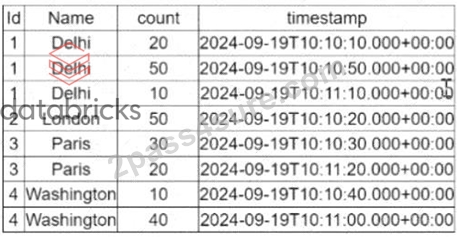
Which operation is supported with streaming_df?
- A. streaming_df.orderBy("timestamp").limit(4)
- B. streaming_df.filter(col("count") < 30).show()
- C. streaming_df.groupby("Id").count()
- D. streaming_df.select(countDistinct("Name"))
Answer: C
Explanation:
Comprehensive and Detailed
Explanation:
In Structured Streaming, only a limited subset of operations is supported due to the nature of unbounded data.
Operations like sorting (orderBy) and global aggregation (countDistinct) require a full view of the dataset, which is not possible with streaming data unless specific watermarks or windows are defined.
Review of Each Option:
A). select(countDistinct("Name"))
Not allowed - Global aggregation like countDistinct() requires the full dataset and is not supported directly in streaming without watermark and windowing logic.
Reference: Databricks Structured Streaming Guide - Unsupported Operations.
B). groupby("Id").count()Supported - Streaming aggregations over a key (like groupBy("Id")) are supported.
Spark maintains intermediate state for each key.Reference: Databricks Docs # Aggregations in Structured Streaming (https://docs.databricks.com/structured-streaming/aggregation.html)
C). orderBy("timestamp").limit(4)Not allowed - Sorting and limiting require a full view of the stream (which is infinite), so this is unsupported in streaming DataFrames.Reference: Spark Structured Streaming - Unsupported Operations (ordering without watermark/window not allowed).
D). filter(col("count") < 30).show()Not allowed - show() is a blocking operation used for debugging batch DataFrames; it's not allowed on streaming DataFrames.Reference: Structured Streaming Programming Guide
- Output operations like show() are not supported.
Reference Extract from Official Guide:
"Operations like orderBy, limit, show, and countDistinct are not supported in Structured Streaming because they require the full dataset to compute a result. Use groupBy(...).agg(...) instead for incremental aggregations."- Databricks Structured Streaming Programming Guide
NEW QUESTION # 35
A data analyst wants to add a column date derived from a timestamp column.
Options:
- A. dates_df.withColumn("date", f.to_date("timestamp")).show()
- B. dates_df.withColumn("date", f.date_format("timestamp", "yyyy-MM-dd")).show()
- C. dates_df.withColumn("date", f.from_unixtime("timestamp")).show()
- D. dates_df.withColumn("date", f.unix_timestamp("timestamp")).show()
Answer: A
Explanation:
f.to_date() converts a timestamp or string to a DateType.
Ideal for extracting the date component (year-month-day) from a full timestamp.
Example:
frompyspark.sql.functionsimportto_date
dates_df.withColumn("date", to_date("timestamp"))
Reference:Spark SQL Date Functions
NEW QUESTION # 36
A Spark engineer is troubleshooting a Spark application that has been encountering out-of-memory errors during execution. By reviewing the Spark driver logs, the engineer notices multiple "GC overhead limit exceeded" messages.
Which action should the engineer take to resolve this issue?
- A. Cache large DataFrames to persist them in memory.
- B. Optimize the data processing logic by repartitioning the DataFrame.
- C. Modify the Spark configuration to disable garbage collection
- D. Increase the memory allocated to the Spark Driver.
Answer: D
Explanation:
Comprehensive and Detailed Explanation From Exact Extract:
The message"GC overhead limit exceeded"typically indicates that the JVM is spending too much time in garbage collection with little memory recovery. This suggests that the driver or executor is under-provisioned in memory.
The most effective remedy is to increase the driver memory using:
--driver-memory 4g
This is confirmed in Spark's official troubleshooting documentation:
"If you see a lot ofGC overhead limit exceedederrors in the driver logs, it's a sign that the driver is running out of memory."
-Spark Tuning Guide
Why others are incorrect:
Amay help but does not directly address the driver memory shortage.
Bis not a valid action; GC cannot be disabled.
Dincreases memory usage, worsening the problem.
NEW QUESTION # 37
A developer is working with a pandas DataFrame containing user behavior data from a web application.
Which approach should be used for executing agroupByoperation in parallel across all workers in Apache Spark 3.5?
A)
Use the applylnPandas API
B)
C)
D)
- A. Use a regular Spark UDF:
from pyspark.sql.functions import mean
df.groupBy("user_id").agg(mean("value")).show() - B. Use theapplyInPandasAPI:
df.groupby("user_id").applyInPandas(mean_func, schema="user_id long, value double").show() - C. Use themapInPandasAPI:
df.mapInPandas(mean_func, schema="user_id long, value double").show() - D. Use a Pandas UDF:
@pandas_udf("double")
def mean_func(value: pd.Series) -> float:
return value.mean()
df.groupby("user_id").agg(mean_func(df["value"])).show()
Answer: B
Explanation:
Comprehensive and Detailed Explanation From Exact Extract:
The correct approach to perform a parallelizedgroupByoperation across Spark worker nodes using Pandas API is viaapplyInPandas. This function enables grouped map operations using Pandas logic in a distributed Spark environment. It applies a user-defined function to each group of data represented as a Pandas DataFrame.
As per the Databricks documentation:
"applyInPandas()allows for vectorized operations on grouped data in Spark. It applies a user-defined function to each group of a DataFrame and outputs a new DataFrame. This is the recommended approach for using Pandas logic across grouped data with parallel execution." Option A is correct and achieves this parallel execution.
Option B (mapInPandas) applies to the entire DataFrame, not grouped operations.
Option C uses built-in aggregation functions, which are efficient but not customizable with Pandas logic.
Option D creates a scalar Pandas UDF which does not perform a group-wise transformation.
Therefore, to run agroupBywith parallel Pandas logic on Spark workers, Option A usingapplyInPandasis the only correct answer.
Reference: Apache Spark 3.5 Documentation # Pandas API on Spark # Grouped Map Pandas UDFs (applyInPandas)
NEW QUESTION # 38
A developer is trying to join two tables,sales.purchases_fctandsales.customer_dim, using the following code:
fact_df = purch_df.join(cust_df, F.col('customer_id') == F.col('custid')) The developer has discovered that customers in thepurchases_fcttable that do not exist in thecustomer_dimtable are being dropped from the joined table.
Which change should be made to the code to stop these customer records from being dropped?
- A. fact_df = purch_df.join(cust_df, F.col('cust_id') == F.col('customer_id'))
- B. fact_df = purch_df.join(cust_df, F.col('customer_id') == F.col('custid'), 'right_outer')
- C. fact_df = cust_df.join(purch_df, F.col('customer_id') == F.col('custid'))
- D. fact_df = purch_df.join(cust_df, F.col('customer_id') == F.col('custid'), 'left')
Answer: D
Explanation:
Comprehensive and Detailed Explanation From Exact Extract:
In Spark, the default join type is an inner join, which returns only the rows with matching keys in both DataFrames. To retain all records from the left DataFrame (purch_df) and include matching records from the right DataFrame (cust_df), a left outer join should be used.
By specifying the join type as'left', the modified code ensures that all records frompurch_dfare preserved, and matching records fromcust_dfare included. Records inpurch_dfwithout a corresponding match incust_dfwill havenullvalues for the columns fromcust_df.
This approach is consistent with standard SQL join operations and is supported in PySpark's DataFrame API.
NEW QUESTION # 39
A data engineer is running a batch processing job on a Spark cluster with the following configuration:
10 worker nodes
16 CPU cores per worker node
64 GB RAM per node
The data engineer wants to allocate four executors per node, each executor using four cores.
What is the total number of CPU cores used by the application?
- A. 0
- B. 1
- C. 2
- D. 3
Answer: A
Explanation:
Comprehensive and Detailed Explanation From Exact Extract:
If each of the 10 nodes runs 4 executors, and each executor is assigned 4 CPU cores:
Executors per node = 4
Cores per executor = 4
Total executors = 4 * 10 = 40
Total cores = 40 executors * 4 cores = 160 cores
However, Spark uses 1 core for overhead on each node when managing multiple executors. Thus, the practical allocation is:
Total usable executors = 4 executors/node × 10 nodes = 40
Total cores = 4 cores × 40 executors = 160
Answer is A - but the question asks specifically about "CPU cores used by the application," assuming all
allocated cores are usable (as Spark typically runs executors without internal core reservation unless explicitly configured).
However, if you are considering 4 executors/node × 4 cores = 16 cores per node, across 10 nodes, that's 160.
Final Answer: A
NEW QUESTION # 40
......
Prepare For Realistic Associate-Developer-Apache-Spark-3.5 Dumps PDF - 100% Passing Guarantee: https://certtree.2pass4sure.com/Databricks-Certification/Associate-Developer-Apache-Spark-3.5-actual-exam-braindumps.html