

Pass Exam Questions Efficiently With AI-900 Questions (2023)
AI-900 Questions - Truly Beneficial For Your Microsoft Exam
Describe NLP Workloads Features on Azure (15-20%)
This domain contains the following details that you need to learn about:
- Identify Azure services & tools for Natural Language Processing Workloads – This topic is created to equip you with the ability to identify various capabilities, such as Speech service, Text Analytics service, Translator Text service, and Language Understanding service.
- Identify the features of basic NLP (Natural Language Processing) Workload Scenarios – The individuals should be able to identify various uses and features of various components, for example, keyphrase extraction, sentiment analysis, entity recognition, translation, language modeling, and speech recognition & synthesis.
NEW QUESTION 25
Your website has a chatbot to assist customers.
You need to detect when a customer is upset based on what the customer types in the chatbot.
Which type of AI workload should you use?
- A. semantic segmentation
- B. regression
- C. anomaly detection
- D. natural language processing
Answer: D
Explanation:
Explanation
Natural language processing (NLP) is used for tasks such as sentiment analysis, topic detection, language detection, key phrase extraction, and document categorization.
Sentiment Analysis is the process of determining whether a piece of writing is positive, negative or neutral.
Reference:
https://docs.microsoft.com/en-us/azure/architecture/data-guide/technology-choices/natural-language-processing
NEW QUESTION 26
You need to develop a mobile app for employees to scan and store their expenses while travelling.
Which type of computer vision should you use?
- A. semantic segmentation
- B. image classification
- C. object detection
- D. optical character recognition (OCR)
Answer: D
Explanation:
Section: Describe features of computer vision workloads on Azure
Explanation:
Azure's Computer Vision API includes Optical Character Recognition (OCR) capabilities that extract printed or handwritten text from images. You can extract text from images, such as photos of license plates or containers with serial numbers, as well as from documents - invoices, bills, financial reports, articles, and more.
Reference:
https://docs.microsoft.com/en-us/azure/cognitive-services/computer-vision/concept-recognizing-text
NEW QUESTION 27
What are two metrics that you can use to evaluate a regression model? Each correct answer presents a complete solution.
NOTE: Each correct selection is worth one point.
- A. root mean squared error (RMSE)
- B. balanced accuracy
- C. F1 score
- D. area under curve (AUC)
- E. coefficient of determination (R2)
Answer: A,E
Explanation:
Explanation
A: R-squared (R2), or Coefficient of determination represents the predictive power of the model as a value between -inf and 1.00. 1.00 means there is a perfect fit, and the fit can be arbitrarily poor so the scores can be negative.
C: RMS-loss or Root Mean Squared Error (RMSE) (also called Root Mean Square Deviation, RMSD), measures the difference between values predicted by a model and the values observed from the environment that is being modeled.
Reference:
https://docs.microsoft.com/en-us/dotnet/machine-learning/resources/metrics
NEW QUESTION 28
You need to develop a web-based AI solution for a customer support system. Users must be able to interact with a web app that will guide them to the best resource or answer.
Which service should you use?
- A. QnA Maker
- B. Translator Text
- C. Face
- D. Custom Vision
Answer: A
Explanation:
QnA Maker is a cloud-based API service that lets you create a conversational Question:-and-answer layer over your existing data. Use it to build a knowledge base by extracting Questions and answers from your semi- structured content, including FAQs, manuals, and documents. Answer users' Questions with the best answers from the QnAs in your knowledge base-automatically. Your knowledge base gets smarter, too, as it continually learns from user behavior.
Incorrect Answers:
A: Azure Custom Vision is a cognitive service that lets you build, deploy, and improve your own image classifiers. An image classifier is an AI service that applies labels (which represent classes) to images, according to their visual characteristics. Unlike the Computer Vision service, Custom Vision allows you to specify the labels to apply.
D: Azure Cognitive Services Face Detection API: At a minimum, each detected face corresponds to a faceRectangle field in the response. This set of pixel coordinates for the left, top, width, and height mark the located face. Using these coordinates, you can get the location of the face and its size. In the API response, faces are listed in size order from largest to smallest.
Reference:
https://azure.microsoft.com/en-us/services/cognitive-services/qna-maker/
NEW QUESTION 29
To complete the sentence, select the appropriate option in the answer area.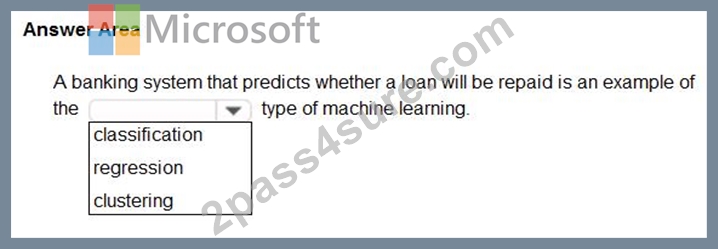
Answer:
Explanation: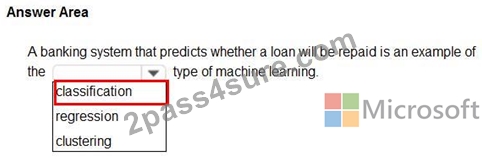
NEW QUESTION 30
For each of the following statements, select Yes if the statement is true. Otherwise, select No.
NOTE: Each correct selection is worth one point.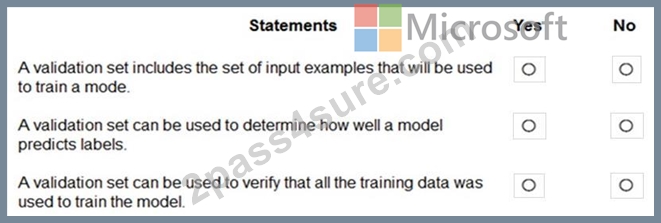
Answer:
Explanation:
Explanation
Graphical user interface, text, application, email Description automatically generated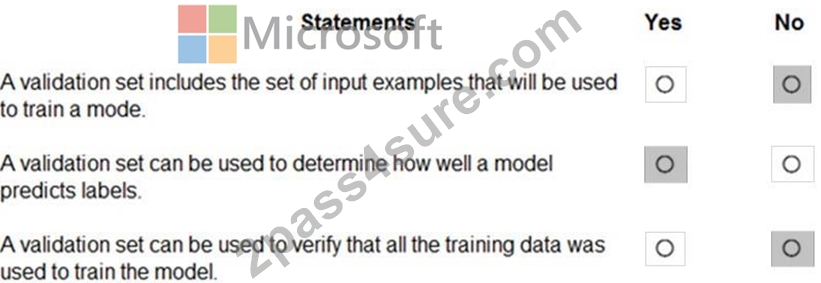
Box 1: No
The validation dataset is different from the test dataset that is held back from the training of the model.
Box 2: Yes
A validation dataset is a sample of data that is used to give an estimate of model skill while tuning model's hyperparameters.
Box 3: No
The Test Dataset, not the validation set, used for this. The Test Dataset is a sample of data used to provide an unbiased evaluation of a final model fit on the training dataset.
Reference:
https://machinelearningmastery.com/difference-test-validation-datasets/
NEW QUESTION 31
In which scenario should you use key phrase extraction?
- A. identifying whether reviews of a restaurant are positive or negative
- B. identifying which documents provide information about the same topics
- C. generating captions for a video based on the audio track
- D. translating a set of documents from English to German
Answer: A
NEW QUESTION 32
For each of the following statements, select Yes if the statement is true. Otherwise, select No.
NOTE: Each correct selection is worth one point.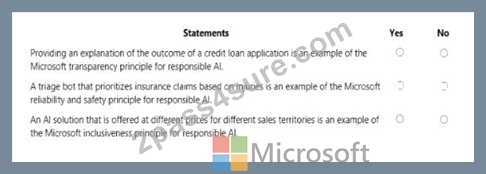
Answer:
Explanation: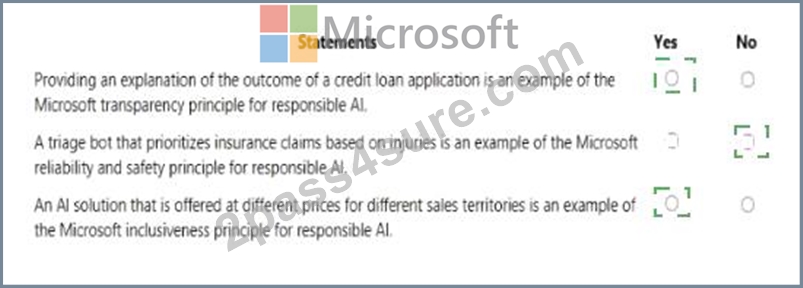
Explanation
Graphical user interface, text, application, email Description automatically generated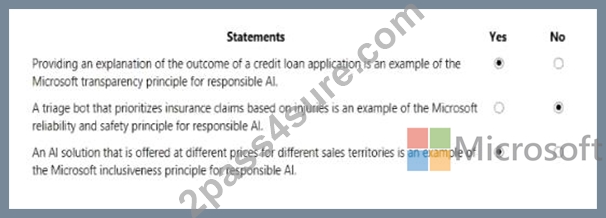
NEW QUESTION 33
For each of the following statements, select Yes if the statement is true. Otherwise, select No.
NOTE: Each correct selection is worth one point.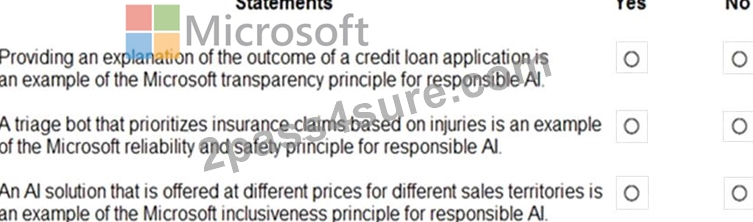
Answer:
Explanation: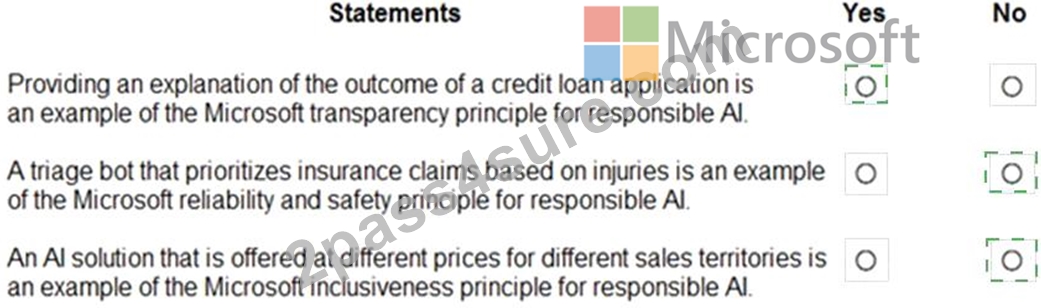
Explanation
Text Description automatically generated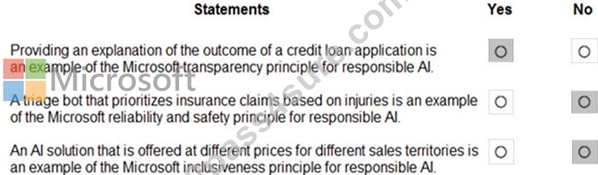
Box 1: Yes
Achieving transparency helps the team to understand the data and algorithms used to train the model, what transformation logic was applied to the data, the final model generated, and its associated assets. This information offers insights about how the model was created, which allows it to be reproduced in a transparent way.
Box 2: No
A data holder is obligated to protect the data in an AI system, and privacy and security are an integral part of this system. Personal needs to be secured, and it should be accessed in a way that doesn't compromise an individual's privacy.
Box 3: No
Inclusiveness mandates that AI should consider all human races and experiences, and inclusive design practices can help developers to understand and address potential barriers that could unintentionally exclude people. Where possible, speech-to-text, text-to-speech, and visual recognition technology should be used to empower people with hearing, visual, and other impairments.
Reference:
https://docs.microsoft.com/en-us/azure/cloud-adoption-framework/innovate/best-practices/trusted-ai
NEW QUESTION 34
For each of the following statements, select Yes if the statement is true. Otherwise, select No.
NOTE: Each correct selection is worth one point.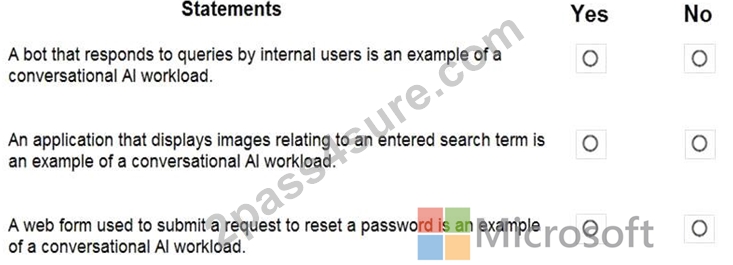
Answer:
Explanation: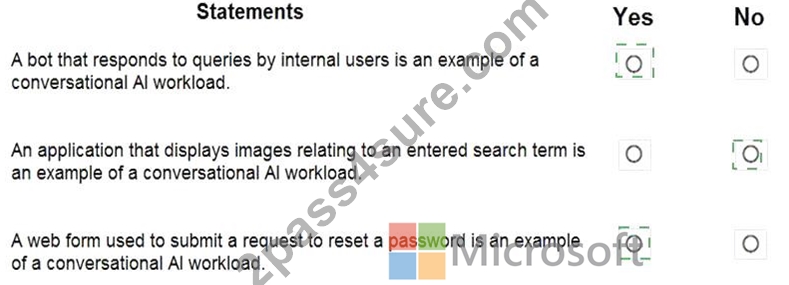
Explanation
Graphical user interface, text, application, email Description automatically generated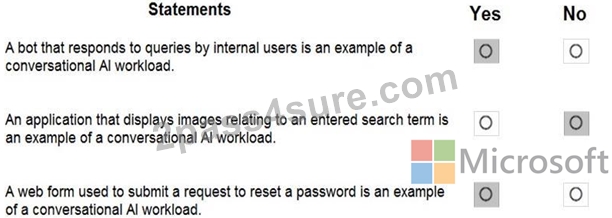
Reference:
https://docs.microsoft.com/en-us/azure/bot-service/bot-service-overview-introduction?view=azure-bot-service-4.
NEW QUESTION 35
You need to scan the news for articles about your customers and alert employees when there is a negative article. Positive articles must be added to a press book.
Which natural language processing tasks should you use to complete the process? To answer, drag the appropriate tasks to the correct locations. Each task may be used once, more than once, or not at all. You may need to drag the split bar between panes or scroll to view content.
NOTE: Each correct selection is worth one point.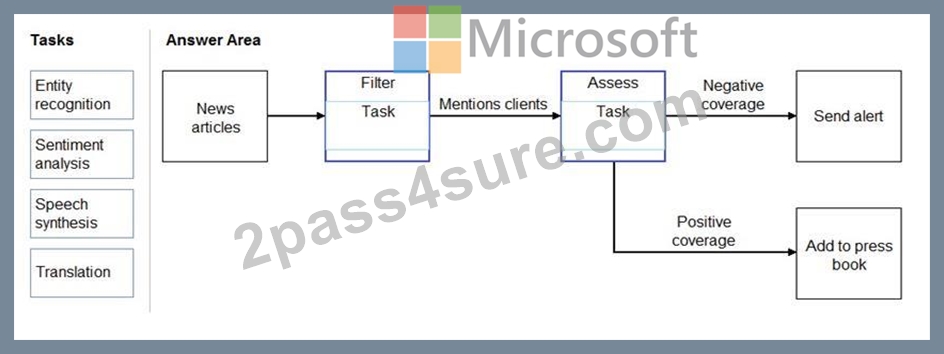
Answer:
Explanation:
Explanation
Diagram Description automatically generated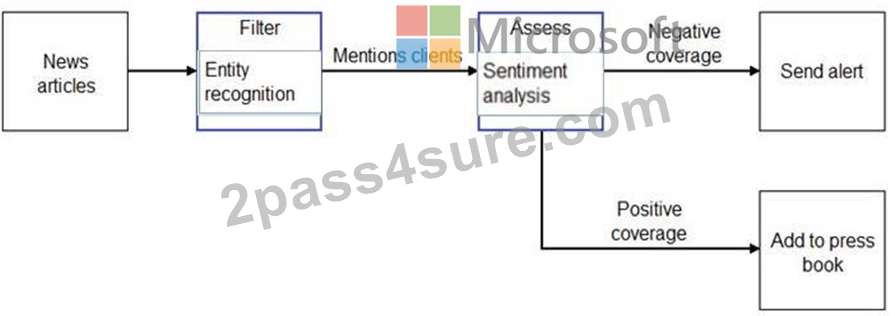
Box 1: Entity recognition
the Named Entity Recognition module in Machine Learning Studio (classic), to identify the names of things, such as people, companies, or locations in a column of text.
Named entity recognition is an important area of research in machine learning and natural language processing (NLP), because it can be used to answer many real-world questions, such as:
* Which companies were mentioned in a news article?
* Does a tweet contain the name of a person? Does the tweet also provide his current location?
* Were specified products mentioned in complaints or reviews?
Box 2: Sentiment Analysis
The Text Analytics API's Sentiment Analysis feature provides two ways for detecting positive and negative sentiment. If you send a Sentiment Analysis request, the API will return sentiment labels (such as "negative",
"neutral" and "positive") and confidence scores at the sentence and document-level.
Reference:
https://docs.microsoft.com/en-us/azure/machine-learning/studio-module-reference/named-entity-recognition
https://docs.microsoft.com/en-us/azure/cognitive-services/text-analytics/how-tos/text-analytics-how-to-sentimen
NEW QUESTION 36
For each of the following statements, select Yes if the statement is true. Otherwise, select No.
NOTE: Each correct selection is worth one point.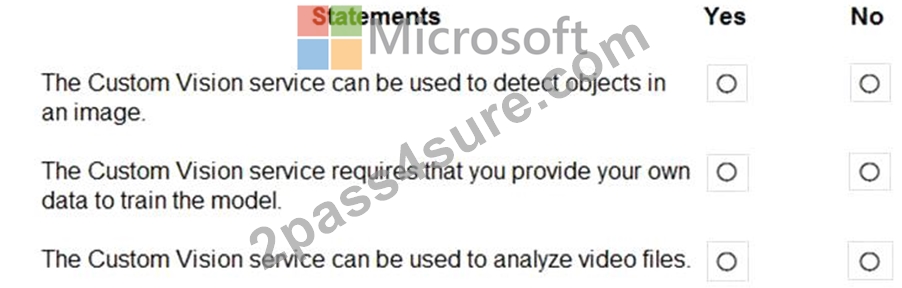
Answer:
Explanation: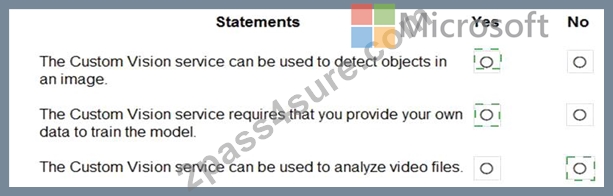
Explanation
A screenshot of a computer Description automatically generated with medium confidence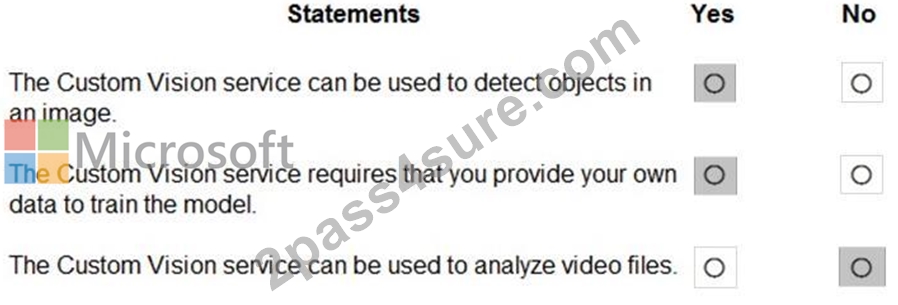
Box 1: Yes
Custom Vision functionality can be divided into two features. Image classification applies one or more labels to an image. Object detection is similar, but it also returns the coordinates in the image where the applied label(s) can be found.
Box 2: Yes
The Custom Vision service uses a machine learning algorithm to analyze images. You, the developer, submit groups of images that feature and lack the characteristics in question. You label the images yourself at the time of submission. Then, the algorithm trains to this data and calculates its own accuracy by testing itself on those same images.
Box 3: No
Custom Vision service can be used only on graphic files.
Reference:
https://docs.microsoft.com/en-us/azure/cognitive-services/Custom-Vision-Service/overview
NEW QUESTION 37
To complete the sentence, select the appropriate option in the answer area.
Answer:
Explanation:
Explanation
Text Description automatically generated
Reference:
https://docs.microsoft.com/en-us/azure/machine-learning/how-to-label-data
NEW QUESTION 38
You have a database that contains a list of employees and their photos.
You are tagging new photos of the employees.
For each of the following statements select Yes if the statement is true. Otherwise, select No.
NOTE: Each correct selection is worth one point.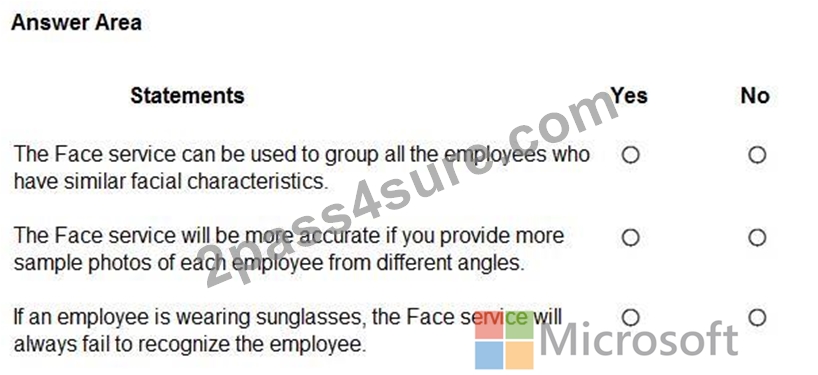
Answer:
Explanation: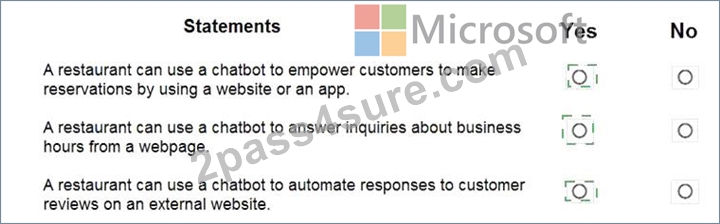
Explanation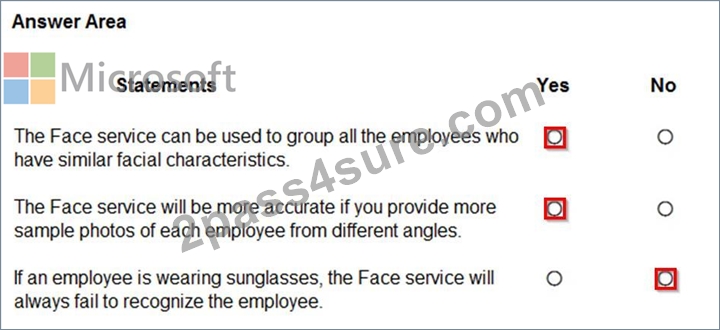
Reference:
https://docs.microsoft.com/en-us/azure/cognitive-services/face/overview
https://docs.microsoft.com/en-us/azure/cognitive-services/face/concepts/face-detection
NEW QUESTION 39
For each of the following statements, select Yes if the statement is true. Otherwise, select No.
NOTE: Each correct selection is worth one point.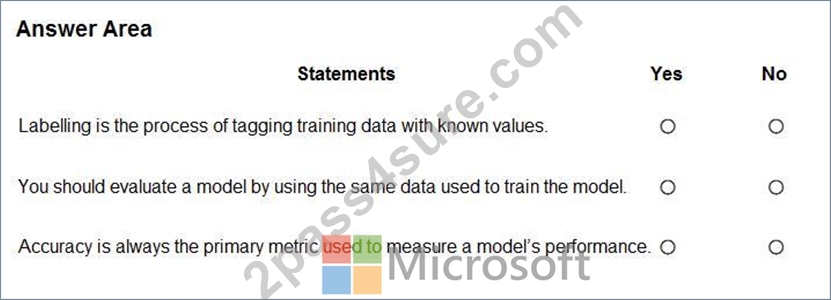
Answer:
Explanation: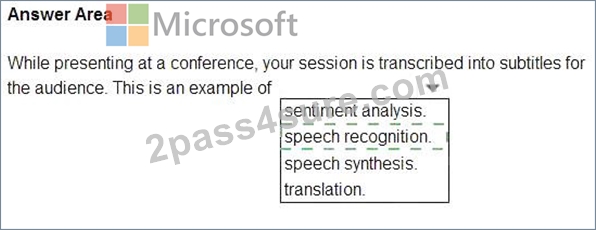
Explanation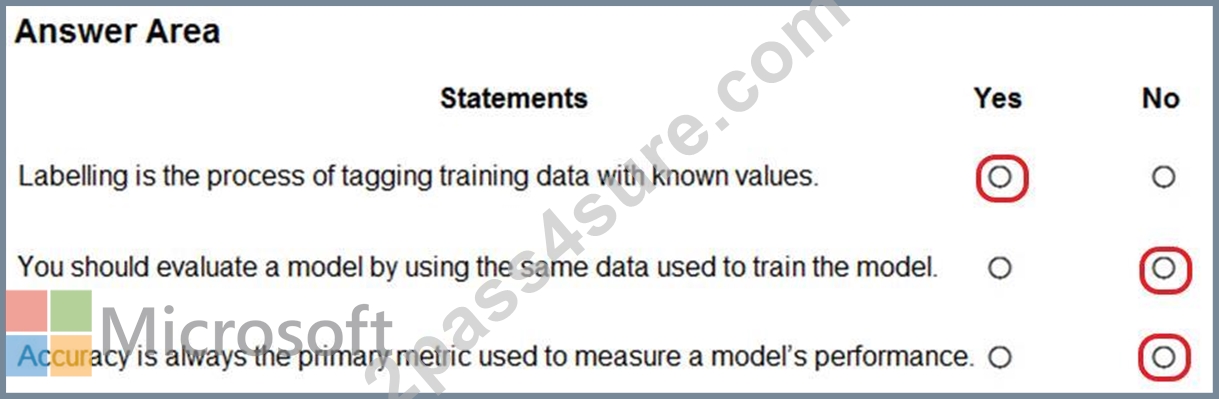
Box 1: Yes
In machine learning, if you have labeled data, that means your data is marked up, or annotated, to show the target, which is the answer you want your machine learning model to predict.
In general, data labeling can refer to tasks that include data tagging, annotation, classification, moderation, transcription, or processing.
Box 2: No
Box 3: No
Accuracy is simply the proportion of correctly classified instances. It is usually the first metric you look at when evaluating a classifier. However, when the test data is unbalanced (where most of the instances belong to one of the classes), or you are more interested in the performance on either one of the classes, accuracy doesn't really capture the effectiveness of a classifier.
Reference:
https://www.cloudfactory.com/data-labeling-guide
https://docs.microsoft.com/en-us/azure/machine-learning/studio/evaluate-model-performance
NEW QUESTION 40
To complete the sentence, select the appropriate option in the answer area.
Computer vision capabilities can be Deployed to....................
Answer:
Explanation:
Integrate a facial recognition feature into an app.
NEW QUESTION 41
To complete the sentence, select the appropriate option in the answer area.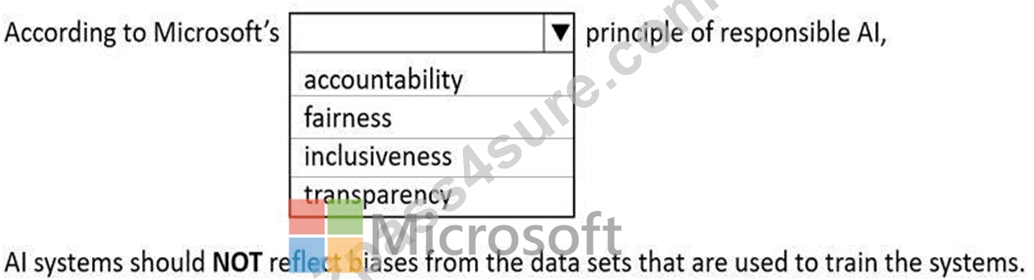
Answer:
Explanation:
Explanation
Diagram, table Description automatically generated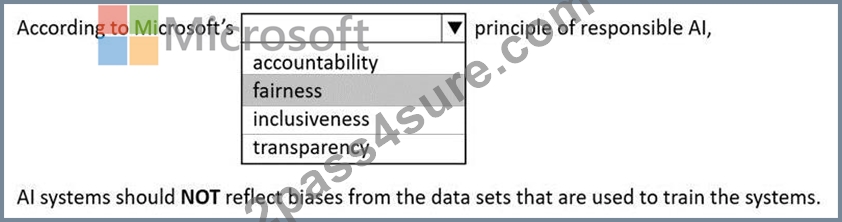
Reference:
https://docs.microsoft.com/en-us/azure/cloud-adoption-framework/innovate/best-practices/trusted-ai
NEW QUESTION 42
A company employs a team of customer service agents to provide telephone and email support to customers.
The company develops a webchat bot to provide automated answers to common customer queries.
Which business benefit should the company expect as a result of creating the webchat bot solution?
- A. increased sales
- B. improved product reliability
- C. a reduced workload for the customer service agents
Answer: C
Explanation:
Section: Describe Artificial Intelligence workloads and considerations
NEW QUESTION 43
You are processing photos of runners in a race.
You need to read the numbers on the runners' shirts to identity the runners in the photos.
Which type of computer vision should you use?
- A. semantic segmentation
- B. object detection
- C. facial recognition
- D. optical character recognition (OCR)
Answer: D
Explanation:
Explanation
Optical character recognition (OCR) allows you to extract printed or handwritten text from images and documents.
Reference:
https://docs.microsoft.com/en-us/azure/cognitive-services/computer-vision/overview-ocr
NEW QUESTION 44
Match the types of natural languages processing workloads to the appropriate scenarios.
To answer, drag the appropriate workload type from the column on the left to its scenario on the right. Each workload type may be used once, more than once, or not at all.
NOTE: Each correct selection is worth one point.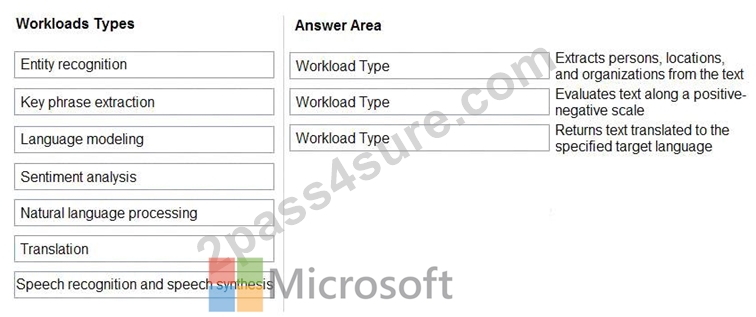
Answer:
Explanation: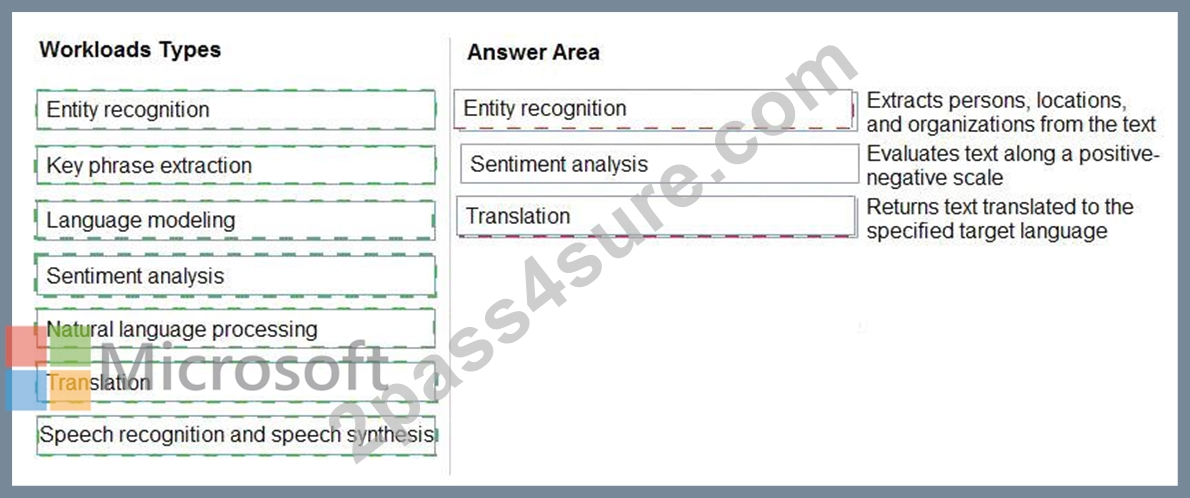
Explanation
Box 1: Entity recognition
Classify a broad range of entities in text, such as people, places, organisations, date/time and percentages, using named entity recognition. Whereas:- Get a list of relevant phrases that best describe the subject of each record using key phrase extraction.
Box 2: Sentiment analysis
Sentiment Analysis is the process of determining whether a piece of writing is positive, negative or neutral.
Box 3: Translation
Using Microsoft's Translator text API
This versatile API from Microsoft can be used for the following:
Translate text from one language to another.
Transliterate text from one script to another.
Detecting language of the input text.
Find alternate translations to specific text.
Determine the sentence length.
Reference:
https://azure.microsoft.com/en-us/services/cognitive-services/text-analytics
NEW QUESTION 45
......
Truly Beneficial For Your Microsoft Exam: https://certtree.2pass4sure.com/Microsoft-Certified-Azure-AI-Fundamentals/AI-900-actual-exam-braindumps.html