

Pass Authentic F5 201 with Free Practice Tests and Exam Dumps
New 201 Exam Questions Real F5 Dumps
Understanding of functional and technical aspects of Troubleshooting basic performance issues
The following will be discussed in this section:
- Use BIG-IP tools in order to identify potential performance issues
- Recognize when a packet capture is needed within the context of a performance issue
- Understand how to get performance statistics in addition to the those shown in the dashboard (Overview - Performance)
- Differentiate between performance issue types (i.e. Latency, Congestion, broken content)
- Establish the frequency of a given issue (random, continuous, isolated, intermittent, repetitive intervals)
F5 201 certification exam is a 90-minute test that consists of 80 multiple-choice questions. 201 exam is designed to assess the individual's knowledge of F5 BIG-IP products and their ability to configure, manage, and troubleshoot these products. 201 exam is administered by Pearson VUE, a well-known provider of computer-based testing services. It can be taken at any Pearson VUE testing center worldwide.
NEW QUESTION # 38
Which process or system can be monitored by the BIG-IP system and used as a failover trigger in a redundant pair configuration?
- A. VLAN communication ability
- B. CPU utilization percentage
- C. bandwidth utilization
- D. duplicate IP address
Answer: A
NEW QUESTION # 39
You need to terminate client SSL traffic at the BIGElIP and also to persist client traffic to the same pool member based on a BIGElIP supplied cookie. Which four are profiles that would normally be included in the virtual server's definition. (Choose four.)
- A. ServerSSL
- B. TCP
- C. HTTPS
- D. CookieElBased Persistence
- E. ClientSSL
- F. HTTP
Answer: B,D,E,F
NEW QUESTION # 40
Refer to the exhibit.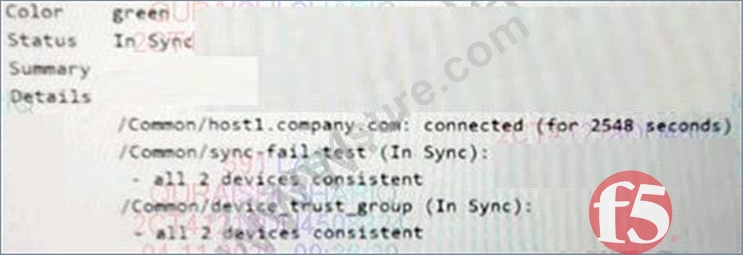
Which TMSH command generated this output?
- A. tmsh list /cm sync-status
- B. tmsh list /sys sync-status
- C. tmsh show /sys sync-status
- D. tmsh show /cm sync status
Answer: D
NEW QUESTION # 41
Assume the bigd daemon fails on the active system. Which three are possible results. (Choose three.)
- A. The active system will continue in active mode but gather member and node state information from the standby system.
- B. The active system will reboot and the standby system will go into active mode.
- C. The active system will restart the bigd daemon and continue in active mode.
- D. The active system will failElover and the standby system will go into active mode.
- E. The active system will restart the tmm daemon and continue in active mode.
Answer: B,C,D
NEW QUESTION # 42
A BIG-IP Administrator suspects that one of the BIG-IP device power supplies is experiencing power outages.
Which log file should the BIG-IP Administrator check to verify the suspicion?
- A. /war /log/daemon.log
- B. /var/log/audit
- C. /var/log/ltm
- D. /var/log/kern.log
Answer: C
NEW QUESTION # 43
Which two can be a part of a pool's definition? (Choose two.)
- A. persistence type
- B. loadbalancing mode
- C. profile(s)
- D. rule(s)
- E. monitor(s)
Answer: B,E
NEW QUESTION # 44
A BIG-IP Administrator is creating a new Trunk on the BIG-IP device. What objects should be added to the new Trunk being created?
- A. Network routes
- B. VLANS
- C. Interfaces
- D. IP addresses
Answer: C
Explanation:
Explanation
trunk is a portchannel, you need to add a physical interface.
NEW QUESTION # 45
A BIG-IP Administrator is conducting maintenance on one BIG-IP appliance in an HA Pair. Why should the BIG-IP Administrator put the appliance into FORCED_OFFLINE state?
- A. To terminate connections to the management IP and decrease persistent connections
- B. To terminate existing connections to Virtual Servers and prevent the appliance from becoming active
- C. To preserve existing connections to Virtual Servers and reduce the CPU load
- D. To allow new connections to Virtual Servers and ensure the appliance becomes active
Answer: B
NEW QUESTION # 46
Which statement is true concerning cookie persistence?
- A. If a client's browser accepts cookies, cookie persistence will always cause a cookie to be written to the client's file system.
- B. Cookie persistence uses a cookie that stores the virtual server, pool name, and member IP address in clear text.
- C. Cookie persistence allows persistence independent of IP addresses.
- D. Cookie persistence allows persistence even if the data are encrypted from client to pool member.
Answer: C
NEW QUESTION # 47
A virtual server is listening at 10.10.1.100:80 and has the following iRule associated with it:
when HTTP_REQUEST { if { [HTTP::header UserAgent] contains "MSIE" }
{ pool MSIE_pool }
else { pool Mozilla_pool }
If a user connects to http://10.10.1.100/foo.html and their browser does not specify a UserAgent, which pool will receive the request?
- A. Mozilla_pool
- B. None. The request will be dropped.
- C. Unknown. The pool cannot be determined from the information provided.
- D. MSIE_pool
Answer: A
NEW QUESTION # 48
Assume a BIG-IP has no NATs or SNATs configured. Which two scenarios are possible when client traffic arrives on a BIG-IP that is NOT destined to a self-IP? (Choose two.)
- A. If the destination of the traffic does not match a virtual server, the traffic will be forwarded based on routing tables.
- B. If the destination of the traffic matches a virtual server, the traffic will be forwarded, but it cannot be loadbalanced since no SNAT has been configured.
- C. If the destination of the traffic does not match a virtual server, the traffic will be discarded.
- D. If the destination of the traffic matches a virtual server, the traffic will be processed per the virtual server definition.
Answer: C,D
NEW QUESTION # 49
A Standard Virtual Server for a web application is configured with Automap for the Source Address Translation option. The original source address of the client must be known by the backend servers. What should the BIG-IP Administrator configure to meet this requirement?
- A. An HTTP Transparent profile
- B. A SNAT Pool with the client IP
- C. The Virtual Server type as Performance (HTTP)
- D. An HTTP profile to insert the X-Forward-For header
Answer: D
Explanation:
Explanation
Because it is a web application, you can insert the source IP in the xff field in the http profile.
NEW QUESTION # 50
Monitors can be assigned to which three resources? (Choose three.)
- A. pool members
- B. virtual servers
- C. SNATs
- D. iRules
- E. NATs
- F. pools
- G. nodes
Answer: A,F,G
NEW QUESTION # 51
You have created a custom profile named TEST2. The parent profile of TEST2 is named TEST1. If additional changes are made to TEST1, what is the effect on TEST2.
- A. Changes to TEST1 cannot affect TEST2 once TEST2 is saved.
- B. Some of the changes to TEST1 may propagate to TEST2.
- C. All changes to TEST1 are propagated to TEST2.
- D. When TEST1 is changed, the administrator is prompted and can choose whether to propagate changes to TEST2.
Answer: B
NEW QUESTION # 52
A custom HTTP monitor is failing to a pool member 10.10.3.75:8080 that serves up www.example.com.
A ping works to the pool member address.
The SEND string that the monitor is using is: GET/HTTP/l.l/r/n/Host.www.example.com/r/n/Connection Close/r/n/r/n Which CLI tool syntax will show that the web server returns the correct HTTP response?
- A. curl-header 'Host:www.example.com' http://10.10.3.75:8080/
- B. curlhttp://10.10.10.3.75:8080/www.example.com/index.html
- C. tracepath 10.10.3.75:8080 GET /index
- D. tracepath 'http://www.example.com:80
Answer: A
NEW QUESTION # 53
A BIG-IP Administrator adds new Pool Members into an existing, highly utilized pool. Soon after, there are reports that the application is failing to load for some users. What pool level setting should the BIG-IP Administrator check?
- A. Action On Service Down
- B. Slow Ramp Time
- C. Allow SNAT
- D. Availability Requirement
Answer: B
Explanation:
Explanation
Option ABC is a global configuration, has nothing to do with the new pool member, select D after excluding
NEW QUESTION # 54
Refer to the exhibit.
Which two pool members are eligible to receive new connections? (Choose two)
- A. 10.21.0.105.80
- B. 10.21.0.102.80
- C. 10.21.0.103.80
- D. 10.21.0.104.80
- E. 10.21.0.101.80
Answer: D,E
NEW QUESTION # 55
Which two can be a part of a virtual server's definition? (Choose two.)
- A. monitor(s)
- B. pool(s)
- C. node address(es)
- D. rule(s)
- E. loadbalancing method(s)
Answer: B,D
NEW QUESTION # 56
Refer to the exhibit.
A BIG-IP Administrator needs to configure health monitors for a newly configured server pool named Pool_B.
Which health monitor settings will ensure that all pool members will be accurately marked as available or unavailable?
- A. HTTPS, HTTP, FTP, and SSH, with the Availability Requirement of at least one monitor
- B. HTTPS, HTTP, FTP, and SSH with the Availability Requirement of all health monitors
- C. HTTPS and HTTP with the Availability Requirement of at least one health monitor
- D. HTTPS, HTTP, FTP, and ICMP, with the Availability Requirement of all health monitors
Answer: A
Explanation:
Explanation
From the port, the four members are HTTP, FTP, HTTPS, and SSH applications. If you want to monitor at the same time, you must configure at least one.
NEW QUESTION # 57
Which method is recommended for creating a new user from the CLI?
- A. Run useradd username' then 'passwd username' from bash tmsh
- B. Run f5adduser username' then 'f5passwd username' from bash or tmsh
- C. Run tmsh create auth user username prompt for password' from bash
- D. edit bigip.conf to add the new user and the user's clear-text password
Answer: C
Explanation:
Reference:
The f5adduser commands were removed and tmsh is the recommended way to create users.
https://support.f5.com/csp/article/K11677
NEW QUESTION # 58
A BIG-IP Administrator sees the following error message in /var/log/ltm diskmonitor: *******; Disk partition shared has less than 30$ free Which section of the Configuration Utility should the BIG-IP Administrator access to investigate this error message?
- A. Statistics > Module Statistics > System
- B. Statistics > Analytics
- C. System > Disk Management
- D. System > File Management
Answer: C
NEW QUESTION # 59
......
F5 201: BIG-IP Administrator exam is a certification that validates one's skills in managing and administering F5 BIG-IP application delivery networks. BIG-IP Administrator Exam certification is designed to equip individuals with the knowledge and skills necessary to configure, manage, and troubleshoot F5 BIG-IP systems.
201 Exam Info and Free Practice Test Professional Quiz Study Materials: https://certtree.2pass4sure.com/F5Networks/201-actual-exam-braindumps.html