

Free Sales Ending Soon - 100% Valid AZ-120 Exam Dumps with 214 Questions
Verified AZ-120 dumps Q&As on your Microsoft Azure Exam Questions Certain Success!
NEW QUESTION # 79
You have an SAP environment that is managed by using VMware vCenter.
You plan to migrate the SAP environment to Azure.
You need to gather information to identify which compute resources are required in Azure.
What should you use to gather the information?
- A. Azure Site Recovery Deployment Planner and SAP HANA Cockpit
- B. SAP Quick Sizer and SAP HANA system replication
- C. Azure Site Recovery and SAP Quick Sizer
- D. Azure Migrate and SAP EarlyWatch Alert reports
Answer: D
Explanation:
Explanation
Azure Migrate is a Microsoft service that helps an enterprise assess how its on-premises workloads will perform, and how much they will cost to host, in the Azure public cloud.
An enterprise can use Azure Migrate to discover information about the VMware VMs running within its own data center, including CPU and memory usage, as well as performance history.
SAP EarlyWatch Alert (EWA) is a monitoring service for SAP customers, to monitor SAP systems in the solution landscape.
NEW QUESTION # 80
For each of the following statements, select Yes if the stamen is true. Otherwise, select No.
NOTE: Each correct selection is worth one point.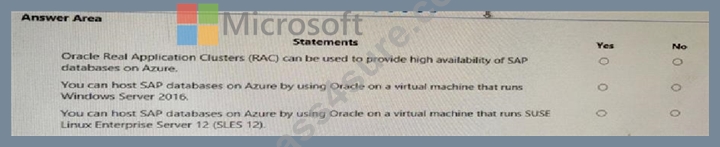
Answer:
Explanation: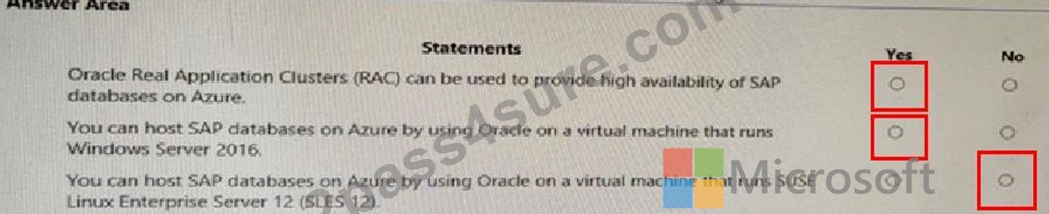
NEW QUESTION # 81
You have an on-premises SAP environment that runs on SUSE Linux Enterprise Server (SLES) servers and Oracle. The version of the SAP ERP system is 6.06 and the version of the portal is SAP NetWeaver 7.3.
You need to recommend a migration strategy to migrate the SAP ERP system and the portal to Azure. The solution must be hosted on SAP HANA.
What should you recommend? To answer, drag the appropriate tools to the correct components. Each tool may be used once, more than once, or not at all. You may need to drag the split bar between panes or scroll to view content.
NOTE: Each correct selection is worth one point.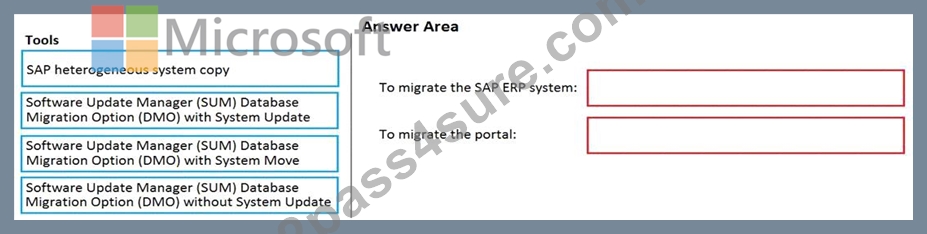
Answer:
Explanation: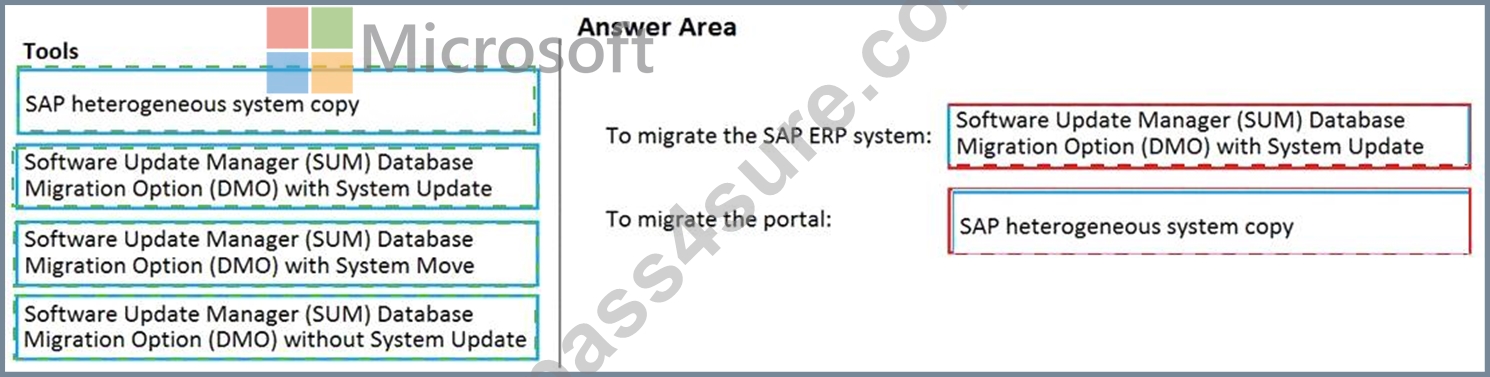
Explanation
1) SUM+DMO+System update.
2) Heterogeneous system copy.
Reference:
https://blogs.sap.com/2017/10/05/your-sap-on-azure-part-2-dmo-with-system-move/
NEW QUESTION # 82
You have an on-premises deployment of SAP HANA that contains a production environment and a development environment.
You plan to migrate both environments to Azure.
You need to identify which Azure virtual machine-series to use for each environment. The solution must meet the following requirements:
* Minimize costs.
* Be SAP HANA-certified.
What should you identify for each requirement? To answer, select the appropriate options in the answer area.
NOTE: Each correct selection is worth one point.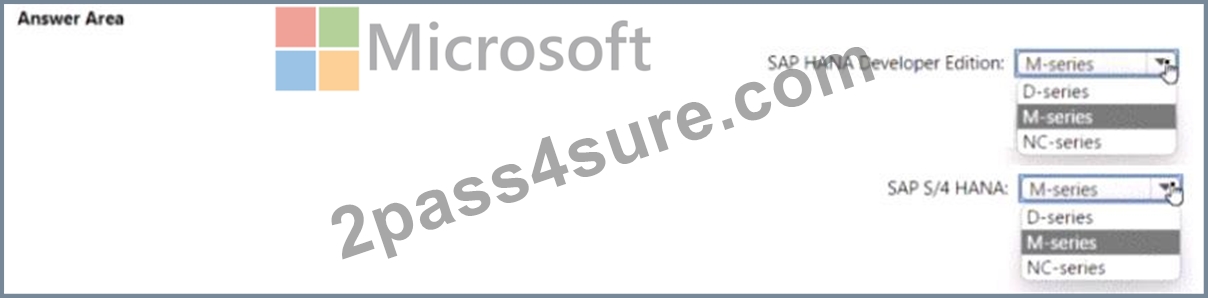
Answer:
Explanation: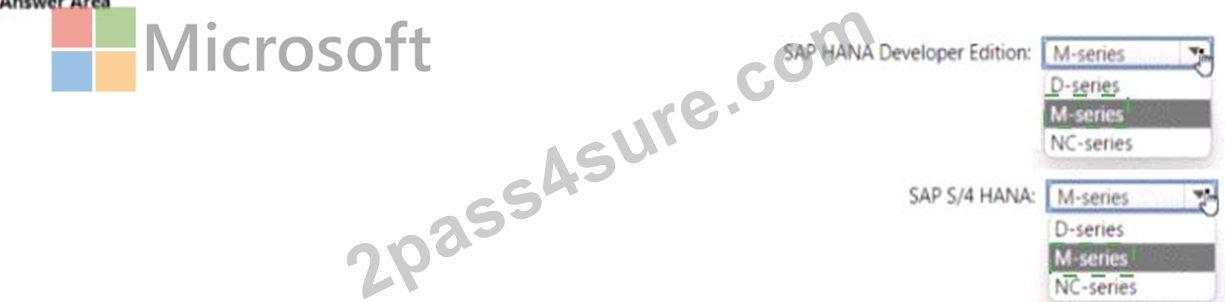
Explanation
NEW QUESTION # 83
You have ah SAP environment on Azure that contains a single-tenant SAP NANA server at instance 03.
You need to monitor the network throughput from an SAP application server to the SAP HANA server.
How should you complete the script? To answer, select the appropriate options in the answer are.
NOTE: Each correct selection is worth one point.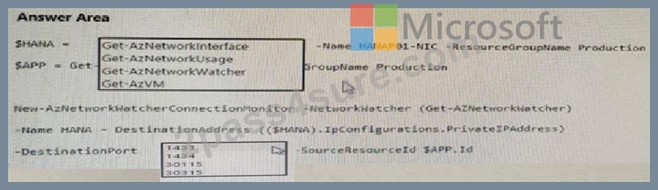
Answer:
Explanation: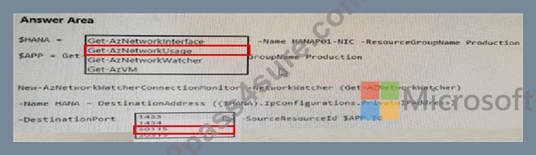
NEW QUESTION # 84
You deploy SAP HANA by using SAP HANA on Azure (Large Instances).
For each of the following statements, select Yes if the statement is true. Otherwise, select No.
NOTE: Each correct selection is worth one point.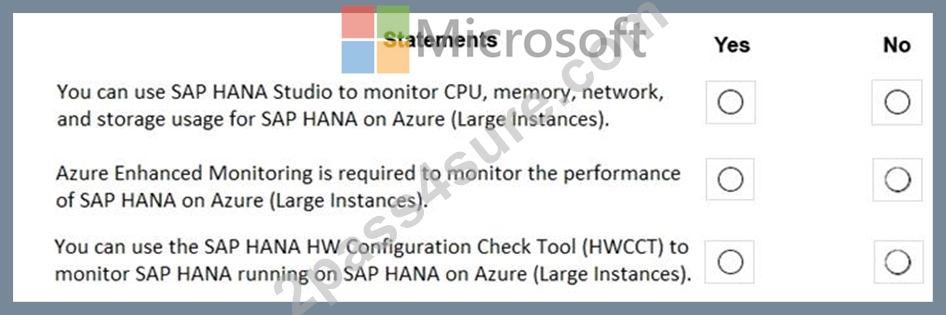
Answer:
Explanation: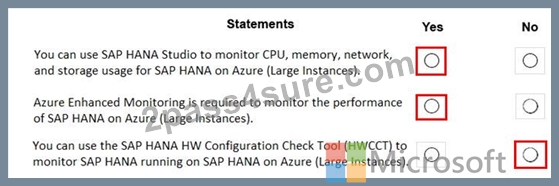
Reference:
http://www.deployazure.com/compute/virtual-machines/sap-azure-enhanced-monitoring-extension/
https://docs.microsoft.com/en-us/azure/virtual-machines/workloads/sap/azure-monitor-overview
NEW QUESTION # 85
You plan to deploy two Azure virtual machines that will host an SAP HANA database for an SAP landscape.
The virtual machines will be deployed to the same availability set. You need to meet the following requirements:
* Ensure that the virtual machines support disk snapshots.
* Ensure that the virtual machine disks provide submillisecond latency for writes.
* Ensure that each virtual machine can be allocated disks from a different storage cluster.
Which type of operating system disk and HANA database disk should you use? To answer, select the appropriate options in the answer area. NOTE Each correct selection is worth one point.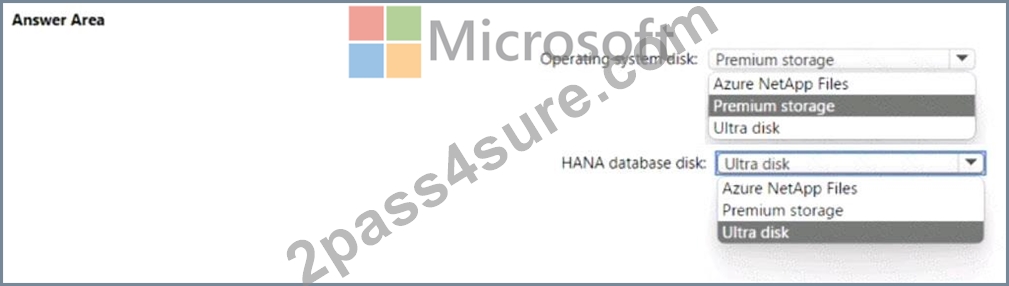
Answer:
Explanation: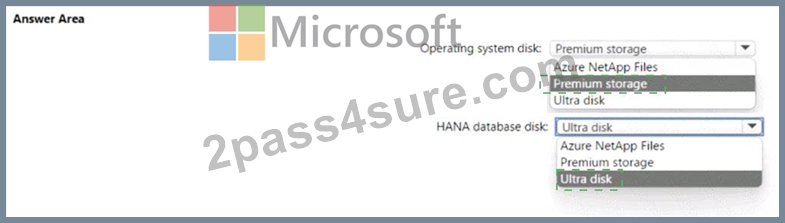
Explanation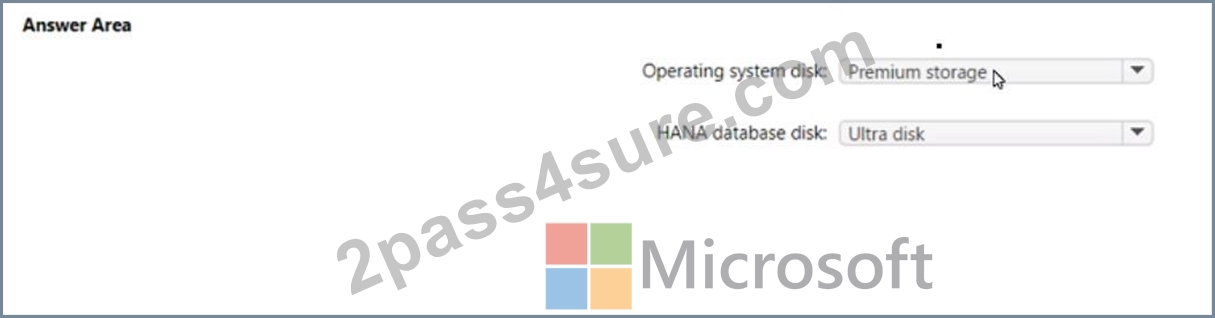
NEW QUESTION # 86
Your on-premises network contains an Active Directory domain.
You are deploying a new SAP environment on Azure.
You need to configure SAP Single Sign-On to ensure that users can authenticate lo SAP GUI and SAP WebGUI.
Which four actions should you perform in sequence? To answer, move the appropriate actions from the list of actions to the answer area and arrange them in the correct order.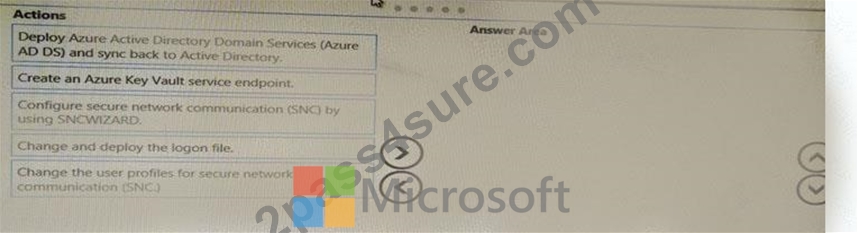
Answer:
Explanation: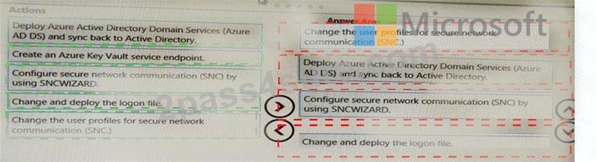
NEW QUESTION # 87
You plan to deploy a high availability SAP environment that will use a failover clustering solution.
You have an Azure Resource Manager template that you will use for the deployment. You have the following relevant portion of the template.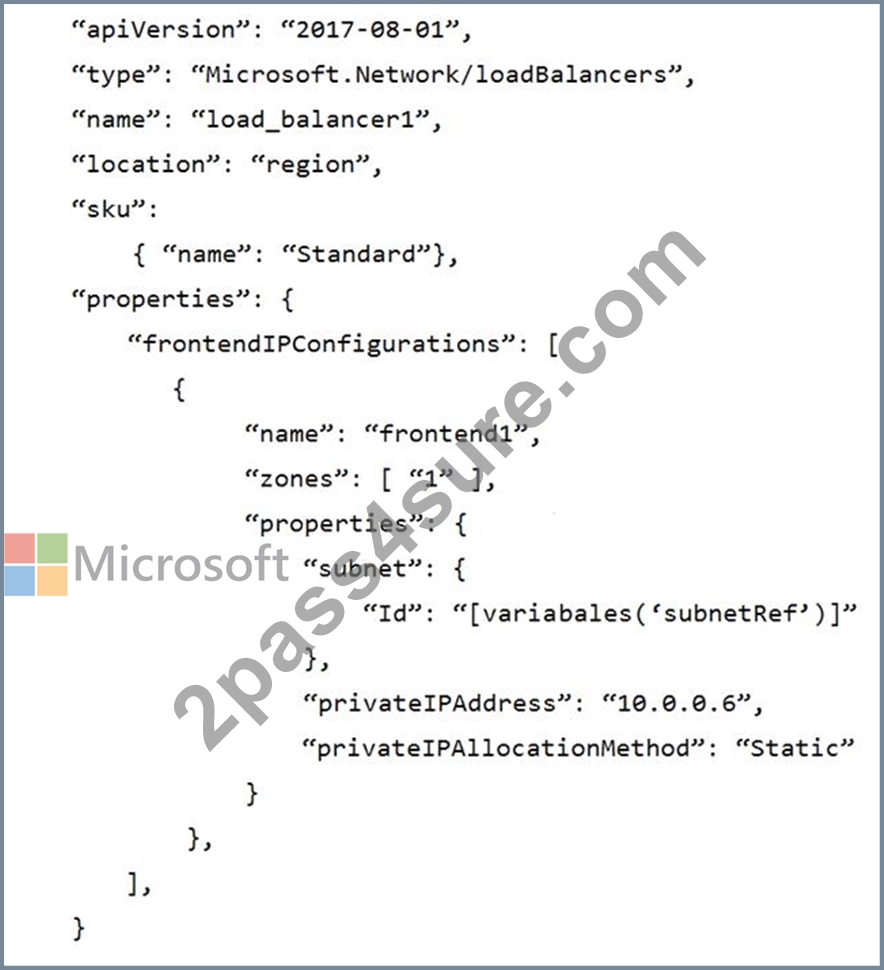
What is created by the template?
- A. a zone -redundant public IP address for the internal load balancer
- B. a zone-redundant frontend IP address for the internal Azure Basic Load Balancer
- C. a zonal frontend IP address for the internal Azure Standard Load Balancer
- D. a zone-redundant frontend IP address for the internal Azure Standard Load Balancer
Answer: D
Explanation:
Reference:
https://docs.microsoft.com/en-us/azure/virtual-machines/workloads/sap/high-availability-guide-standard-load-balancer-outbound-connections
NEW QUESTION # 88
You plan to migrate an SAP environment to Azure.
You need to create a design to facilitate end-user access to SAP applications over the Internet, while restricting user access to the virtual machines of the SAP application servers.
What should you include in the design?
- A. Use an SAP Web Dispatcher to route all incoming connections
- B. Configure a public IP address for each SAP application server
- C. Deploy an internal Azure Standard Load Balancer for incoming connections
- D. Configure point-to-site VPN connections for each user
Answer: A
Explanation:
Explanation
A public internet user can reach the SAP Web-Dispatcher over port 443
The SAP Web-Dispatcher can reach the SAP Application server over port 443 The App Subnet accepts traffic on port 443 from 10.0.0.0/24 The SAP Application server sends traffic on port 30015 to the SAP DB server The DB subnet accepts traffic on port 30015 from 10.0.1.0/24.
Public Internet Access is blocked on both App Subnet and DB Subnet.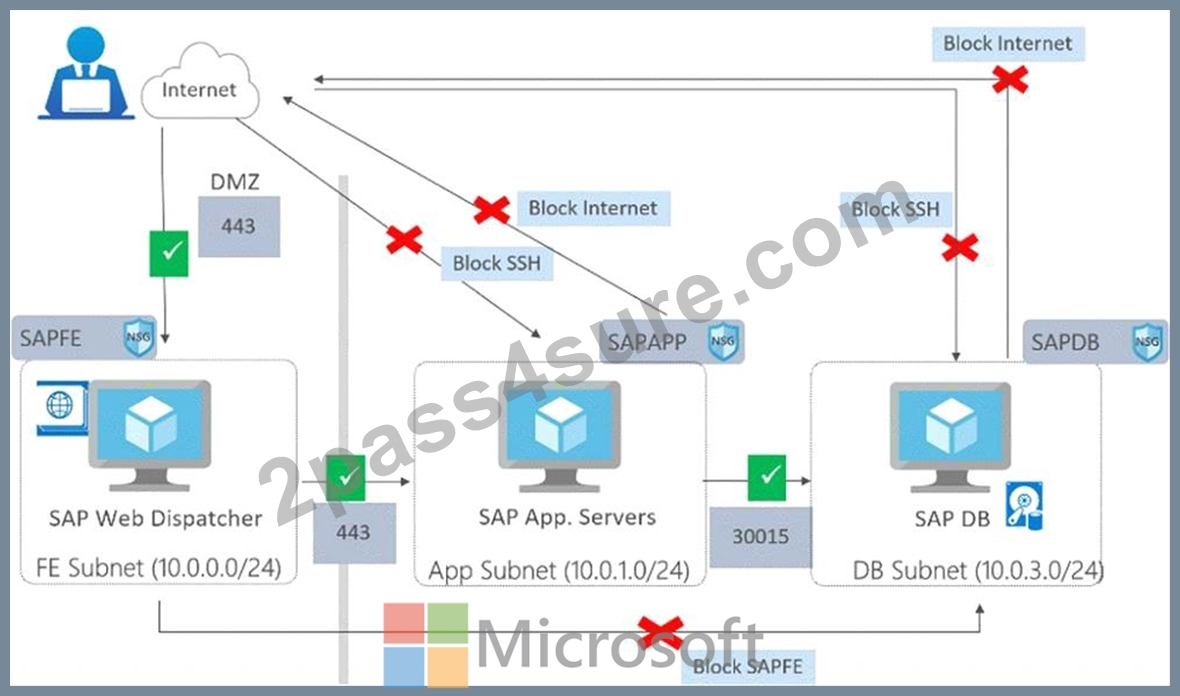
References:
https://azure.microsoft.com/en-in/blog/sap-on-azure-architecture-designing-for-security/
NEW QUESTION # 89
For each of the following statements, select Yes if the stamen is true. Otherwise, select No.
NOTE: Each correct selection is worth one point.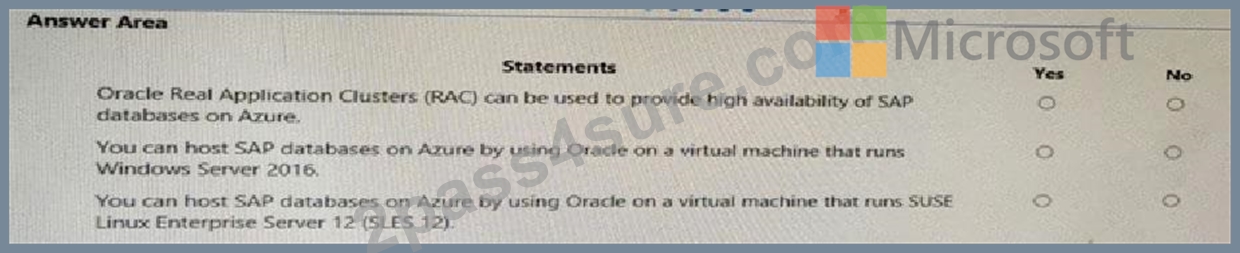
Answer:
Explanation: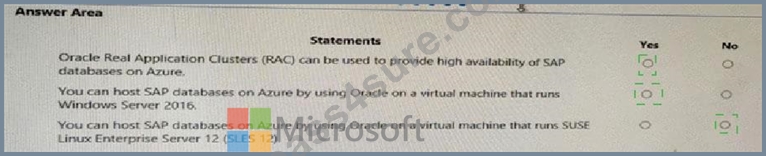
Explanation
Yes, Yes, No
NEW QUESTION # 90
You have an on-premises deployment of SAP HANA.
You plan to migrate the deployment to Azure.
You need to identify the following from the last six months:
The number of active users
The database performance
What should you do? To answer, select the appropriate options in the answer area.
NOTE:Each correct selection is worth one point.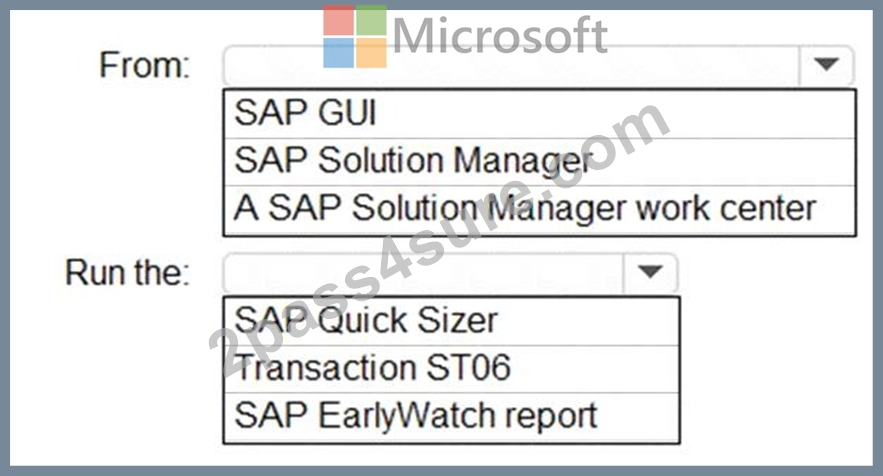
Answer:
Explanation: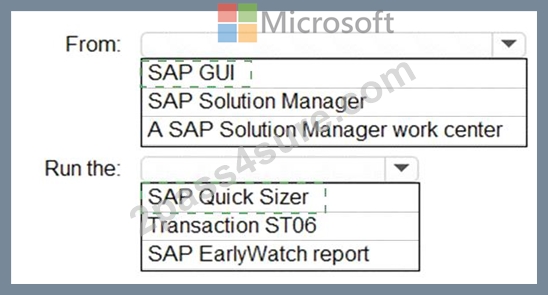
Reference:
https://assets.cdn.sap.com/sapcom/docs/2019/09/0e8d0628-687d-0010-87a3-c30de2ffd8ff.pdf
NEW QUESTION # 91
For each of the following statements, select Yes if the statement is true. Otherwise, select No.
NOTE: Each correct selection is worth one point.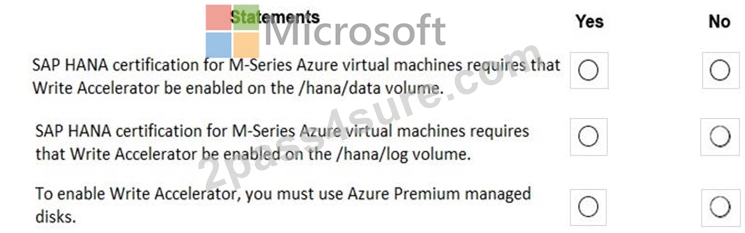
Answer:
Explanation: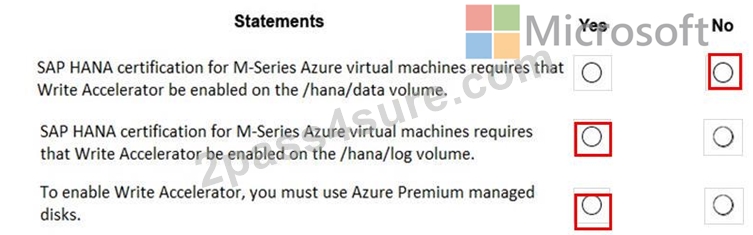
Reference:
https://docs.microsoft.com/en-us/azure/virtual-machines/workloads/sap/hana-vm-operations-storage
NEW QUESTION # 92
You plan to deploy an SAP landscape that will have virtual machines deployed to multiple Azure regions.
You need to ensure that the virtual machines can communicate across the regions.
What should you configure?
- A. virtual network peering in Azure
- B. local network gateways
- C. Azure Bastion hosts
- D. Azure Relay
Answer: A
Explanation:
Depending on the rules and restrictions you want to apply between the different virtual networks hosting VMs of different SAP systems, you should peer those virtual network Note: Virtual network peering enables you to seamlessly connect two or more Virtual Networks in Azure. The virtual networks appear as one for connectivity purposes. The traffic between virtual machines in peered virtual networks uses the Microsoft backbone infrastructure. Like traffic between virtual machines in the same network, traffic is routed through Microsoft's private network only.
Azure supports the following types of peering:
Virtual network peering: Connect virtual networks within the same Azure region.
Global virtual network peering: Connecting virtual networks across Azure regions.
Reference:
https://docs.microsoft.com/en-us/azure/virtual-machines/workloads/sap/hana-network-architecture
https://docs.microsoft.com/en-us/azure/virtual-network/virtual-network-peering-overview
NEW QUESTION # 93
You deploy an Azure Internal load balancer.
You deploy a node of an SAP NetWeaver 7.4 ABAP system named SP1.
You plan to deploy a second node.
You need to verify that the health probe port is configured for the cluster. The cluster IP address resource name is SAP SP1 IP.
How should you complete the command? To answer, select the appropriate options in the answer area.
NOTE: Each correct selection is worth one point.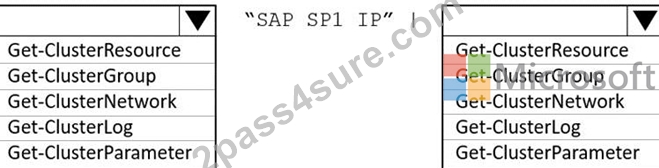
Answer:
Explanation: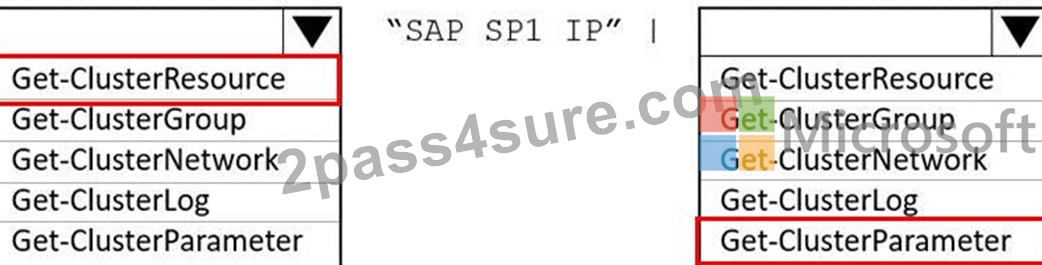
Reference:
https://docs.microsoft.com/en-us/azure/virtual-machines/workloads/sap/sap-high-availability-installation-wsfc-shared-disk
NEW QUESTION # 94
You need to recommend a solution to reduce the cost of the SAP non-production landscapes after the migration.
What should you include in the recommendation?
- A. Deallocate virtual machines when not in use
- B. Deploy non-production landscapes to Azure DevTest Labs
- C. Migrate the SQL Server databases to Azure SQL Data Warehouse
- D. Configure scaling of Azure App Service
Answer: B
Explanation:
Relevant use cases Dev/test environments for SAP workloads on Azure.
Noncritical SAP nonproduction workloads (such sandbox, development, test, and quality assurance).
Noncritical SAP business workloads.
References:
https://docs.microsoft.com/en-us/azure/architecture/example-scenario/apps/sap-dev-test Build and Deploy Azure SAP Workloads Testlet 2 Case Study This is a case study. Case studies are not timed separately. You can use as much exam time as you would like to complete each case. However, there may be additional case studies and sections on this exam. You must manage your time to ensure that you are able to complete all questions included on this exam in the time provided.
To answer the questions included in a case study, you will need to reference information that is provided in the case study. Case studies might contain exhibits and other resources that provide more information about the scenario that is described in the case study. Each question is independent of the other questions in this case study.
At the end of this case study, a review screen will appear. This screen allows you to review your answers and to make changes before you move to the next section of the exam. After you begin a new section, you cannot return to this section.
To start the case study
To display the first question in this case study, click the Next button. Use the buttons in the left pane to explore the content of the case study before you answer the questions. Clicking these buttons displays information such as business requirements, existing environment, and problem statements. If the case study has an All Information tab, note that the information displayed is identical to the information displayed on the subsequent tabs. When you are ready to answer a question, click the Question button to return to the question.
Overview
Contoso, Ltd. is a manufacturing company that has 15,000 employees.
The company uses SAP for sales and manufacturing.
Contoso has sales offices in New York and London and manufacturing facilities in Boston and Seattle.
Existing Environment
Active Directory
The network contains an on-premises Active Directory domain named ad.contoso.com. User email addresses use a domain name of contoso.com.
SAP Environment
The current SAP environment contains the following components:
* SAP Solution Manager
* SAP ERP Central Component (SAP ECC)
* SAP Supply Chain Management (SAP SCM)
* SAP application servers that run Windows Server 2008 R2
* SAP HANA database servers that run SUSE Linux Enterprise Server 12 (SLES 12) Problem Statements Contoso identifies the following issues in its current environment:
* The SAP HANA environment lacks adequate resources.
* The Windows servers are nearing the end of support.
* The datacenters are at maximum capacity.
Requirements
Planned Changes
Contoso identifies the following planned changes:
* Deploy Azure Virtual WAN.
* Migrate the application servers to Windows Server 2016.
* Deploy ExpressRoute connections to all of the offices and manufacturing facilities.
* Deploy SAP landscapes to Azure for development, quality assurance, and production.
All resources for the production landscape will be in a resource group named SAPProduction.
Business goals
Contoso identifies the following business goals:
* Minimize costs whenever possible.
* Migrate SAP to Azure without causing downtime.
* Ensure that all SAP deployments to Azure are supported by SAP.
* Ensure that all the production databases can withstand the failure of an Azure region.
* Ensure that all the production application servers can restore daily backups from the last 21 days.
Technical Requirements
Contoso identifies the following technical requirements:
* Inspect all web queries.
* Deploy an SAP HANA cluster to two datacenters.
* Minimize the bandwidth used for database synchronization.
* Use Active Directory accounts to administer Azure resources.
* Ensure that each production application server has four 1-TB data disks.
* Ensure that an application server can be restored from a backup created during the last five days within 15 minutes.
* Implement an approval process to ensure that an SAP administrator is notified before another administrator attempts to make changes to the Azure virtual machines that host SAP.
It is estimated that during the migration, the bandwidth required between Azure and the New York office will be
1 Gbps. After the migration, a traffic burst of up to 3 Gbps will occur.
Proposed Backup Policy
An Azure administrator proposes the backup policy shown in the following exhibit.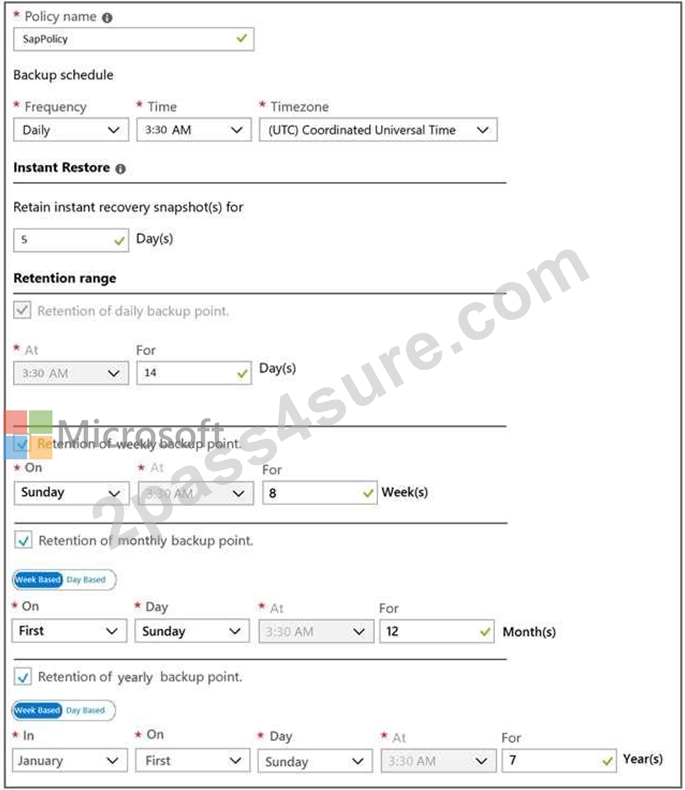
Azure Resource Manager Template
An Azure administrator provides you with the Azure Resource Manager template that will be used to provision the production application servers.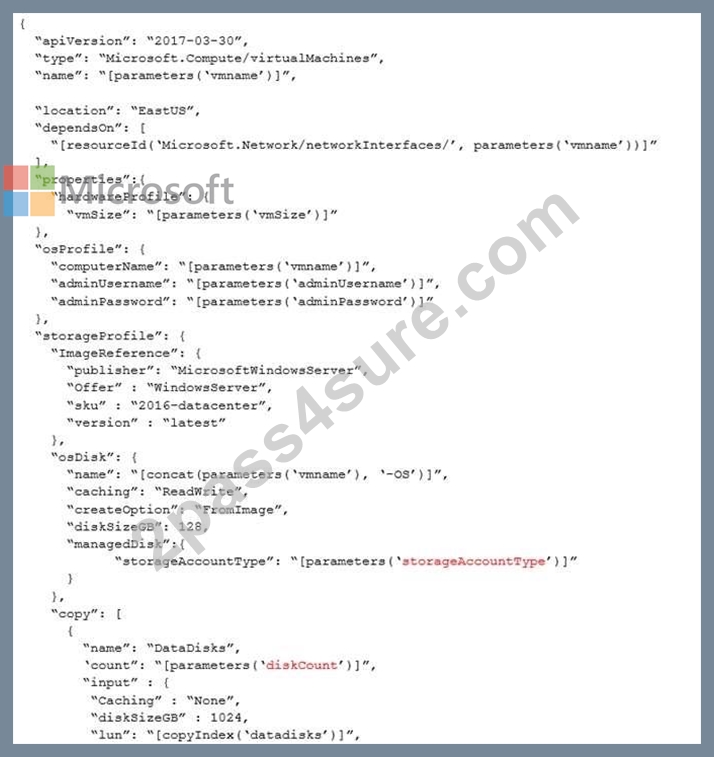

NEW QUESTION # 95
You are validating an SAP HANA on Azure (Large Instances) deployment.
You need to ensure that sapconf is installed and the kernel parameters are set appropriately for the active profile.
How should you complete the commands? To answer, drag the appropriate values to the correct targets. Each value may be used once, more than once, or not at all. You may need to drag the split bar between panes or scroll to view content.
NOTE: Each correct selection is worth one point.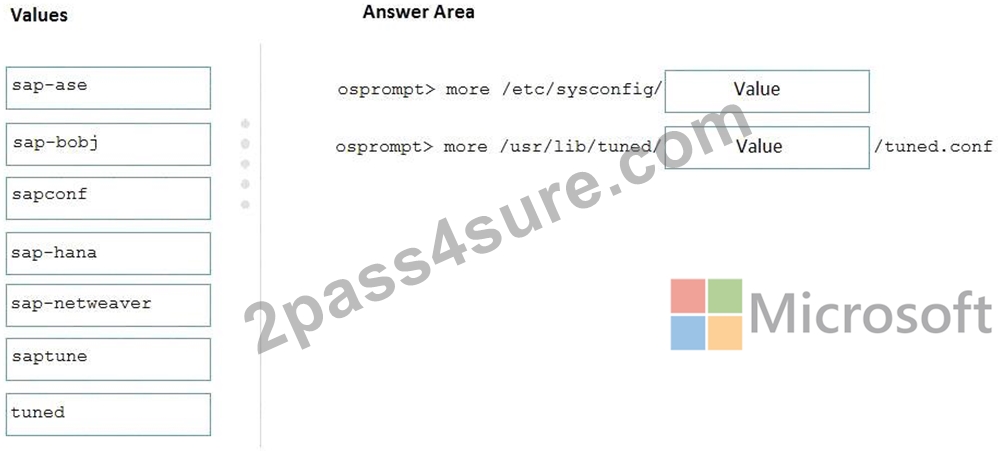
Answer:
Explanation: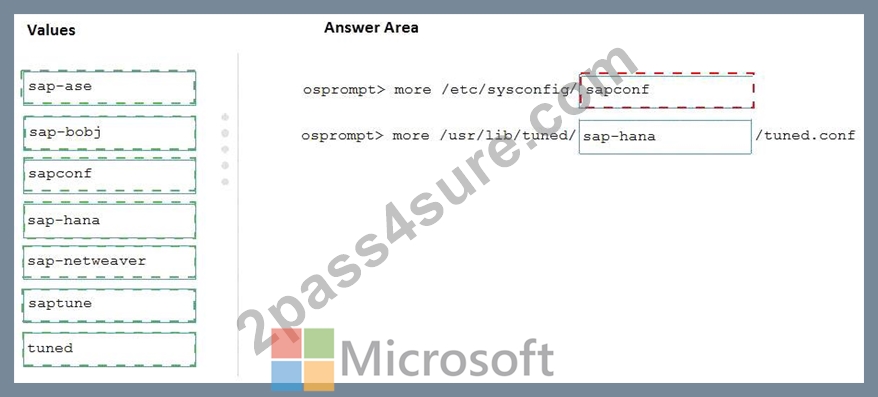
Explanation
Box 1: sapconf
The configuration is split into two parts:
/etc/sysconfig/sapconf
/usr/lib/tuned//tuned.conf
Box 2: sap-hana
References:
https://blogs.sap.com/2017/12/22/prepare-your-linux-for-your-sap-solution-with-saptune/
NEW QUESTION # 96
For each of the following statements, select Yes if the statement is true. Otherwise, select No.
NOTE: Each correct selection is worth one point.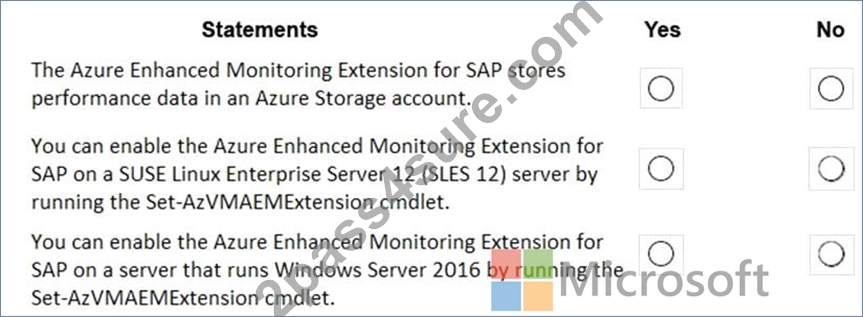
Answer:
Explanation: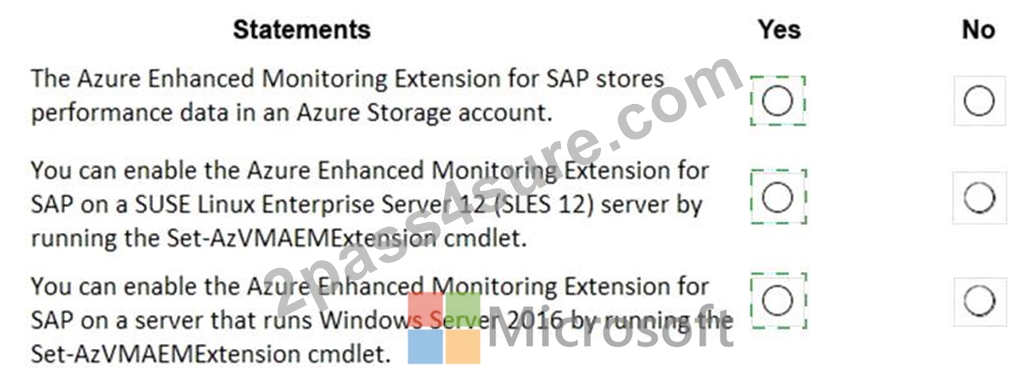
Explanation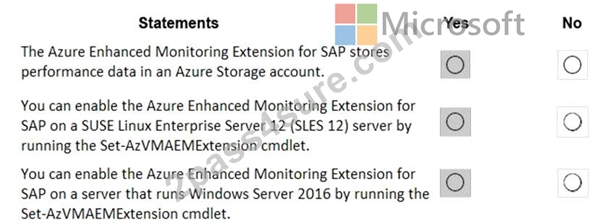
Box 1: Yes
The SAP Azure Enhanced Monitoring Extension builds on top of the Azure Diagnostic extension, which stores its data in an Azure Storage account that you specify.
Box 2: Yes
The Set-AzVMAEMExtension cmdlet updates the configuration of a virtual machine to enable or update the support for monitoring for SAP systems that are installed on the virtual machine. The cmdlet installs the Azure Enhanced Monitoring (AEM) extension that collects the performance data and makes it discoverable for the SAP system.
The -OSType specifies the OS. Either Windows or Linux.
Box 3: Yes
References:
https://docs.microsoft.com/en-us/azure/azure-monitor/platform/diagnostics-extension-overview
https://docs.microsoft.com/en-us/powershell/module/az.compute/set-azvmaemextension
NEW QUESTION # 97
You have an on-premises SAP landscape that uses a DB2 database and contains an SAP Financial Accounting (SAP FIN) deployment. The deployment contains a file share that stores 50 TB of bitmap files. You plan to migrate the on-premises SAP landscape to SAP HANA on Azure (Large Instances) and Azure Files shares.
The solution must meet the following requirements:
* Minimize downtime.
* Minimize administrative effort.
You need to recommend a migration solution.
What should you recommend for each resource? To answer, drag the appropriate services to the correct resources. Each service may be used once, more than once, or not at all. You may need to drag the split bar between panes or scroll to view content.
NOTE: Each correct selection is worth one point.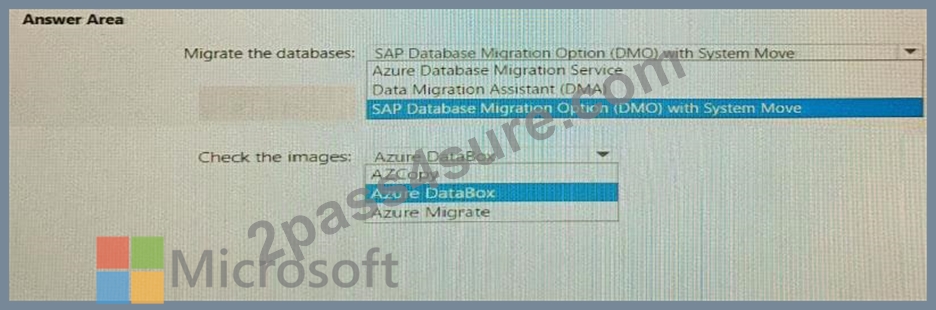
Answer:
Explanation: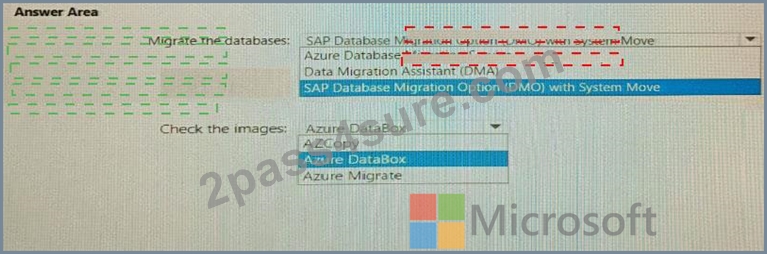
Explanation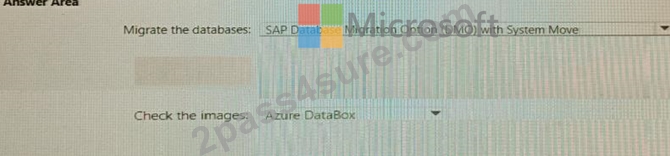
NEW QUESTION # 98
You are evaluating the proposed backup policy.
For each of the following statements, select Yes if the statement is true. otherwise, select No.
NOTE: Each correct selection is worth one point.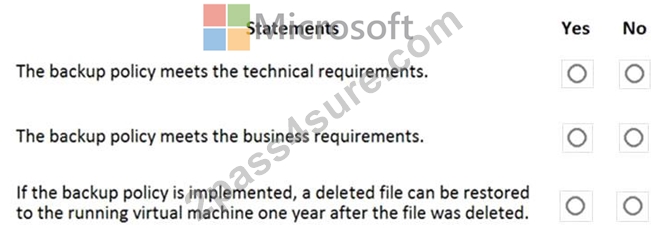
Answer:
Explanation: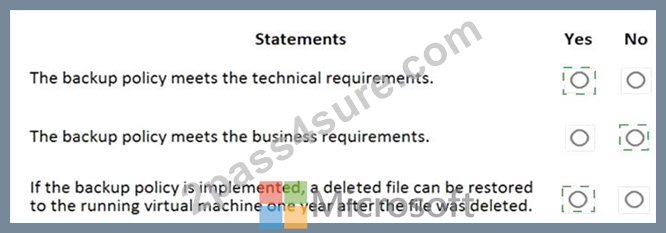
Explanation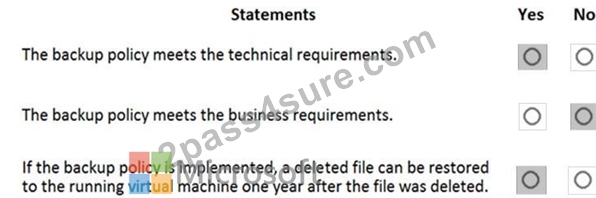
Box 1: Yes
Scenario: Technical requirements: Ensure that an application server can be restored from a backup created during the last five days within 15 minutes.
Instant Restore has 'The instance recovery snapshot(s) for 5 Day(s)'.
Box 2: No
Scenario: Ensure that all the production application servers can restore daily backups from the last 21 days.
The Retention of daily backup point is set to for 14 days only.
Box 3: Yes
Reference:
https://docs.microsoft.com/en-us/azure/backup/backup-instant-restore-capability
NEW QUESTION # 99
You plan to migrate an on-premises SAP development system to Azure.
Before the migration, you need to check the usage of the source system hardware, such as CPU, memory, network, etc.
Which transaction should you run from SAP GUI?
- A. DB01
- B. OS07N
- C. DB12
- D. SM51
Answer: B
Explanation:
SAP transaction OS07N (Remote Operating System Activity) is classified in the Basis Component module under application component Operating System Monitors and runs Monitoring Operating System program RSHOST1N upon execution.
Incorrect Answers:
A: Transaction code SM51 is to display list of active application servers that have registered in the SAP message server.
B: DB01 is a transaction code used for Analyze Exclusive Lockwaits in SAP.
C: Transaction code DB12 is to collects and presents information that is necessary to monitor database backups.
Reference:
http://www.saptransactions.com/codes/OS07N/
NEW QUESTION # 100
You need to provide the Azure administrator with the values to complete the Azure Resource Manager template.
Which values should you provide for diskCount, StorageAccountType, and domainName? To answer, select the appropriate options in the answer area.
NOTE: Each correct selection is worth one point.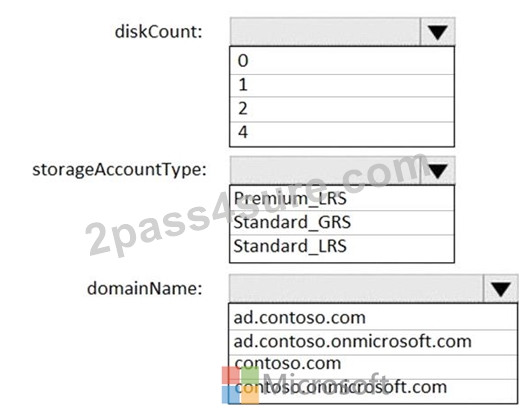
Answer:
Explanation: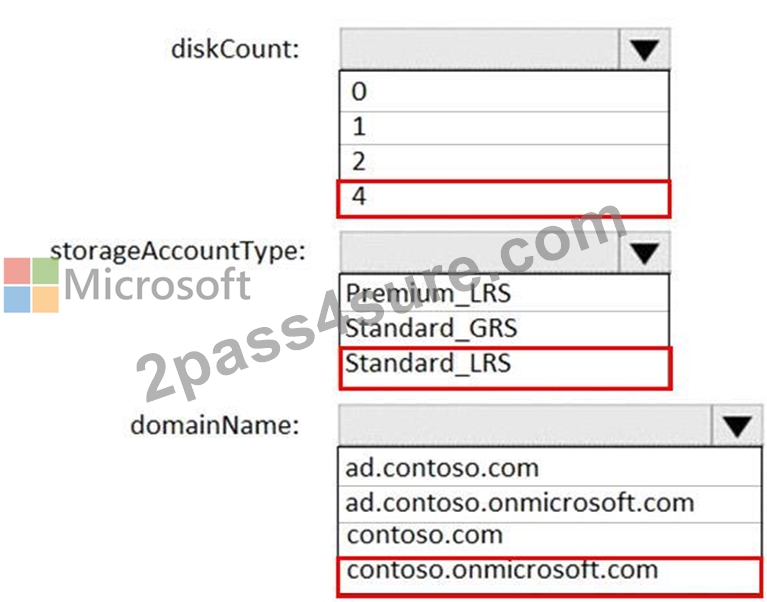
Explanation:
Box 1: 4
Scenario: the Azure Resource Manager template that will be used to provision the production application servers.
Ensure that each production application server has four 1-TB data disks.
Box 2: Standard_LRS
Scenario: Minimize costs whenever possible.
Box 3: contoso.onmicrosoft.com
The network contains an on-premises Active Directory domain named ad.contoso.com.
The Initial domain: The default domain (onmicrosoft.com) in the Azure AD Tenant. For example, contoso.onmicrosoft.com.
References:
https://docs.microsoft.com/en-us/azure/active-directory/hybrid/plan-connect-userprincipalname
NEW QUESTION # 101
......
AZ-120 Exam Dumps - 100% Marks In AZ-120 Exam: https://certtree.2pass4sure.com/Microsoft-Azure/AZ-120-actual-exam-braindumps.html