

[2026] Verified L4M5 Dumps Q&As - 1 Year Free & Quickly Updates
Latest 2026 Realistic Verified L4M5 Dumps - 100% Free L4M5 Exam Dumps
NEW QUESTION # 220
When is the best time in procurement process in which procurement should get involved so that the cost- saving opportunities are the greatest?
- A. Post-tender stage
- B. Post-contract stage
- C. Market consult stage
- D. Specification stage
Answer: D
Explanation:
The earlier procurement get involved in the procurement processes, the better. If procurement are involved in design at the specification stage they can feed in prices and costs to designer so they know the likely budget implication of choices made. Sending in a procurement team to negotiate at or close to the end of the procurement process effectively ties their hands and limits their negotiation leverage. This is illustrated in the graph below:
Chart Description automatically generated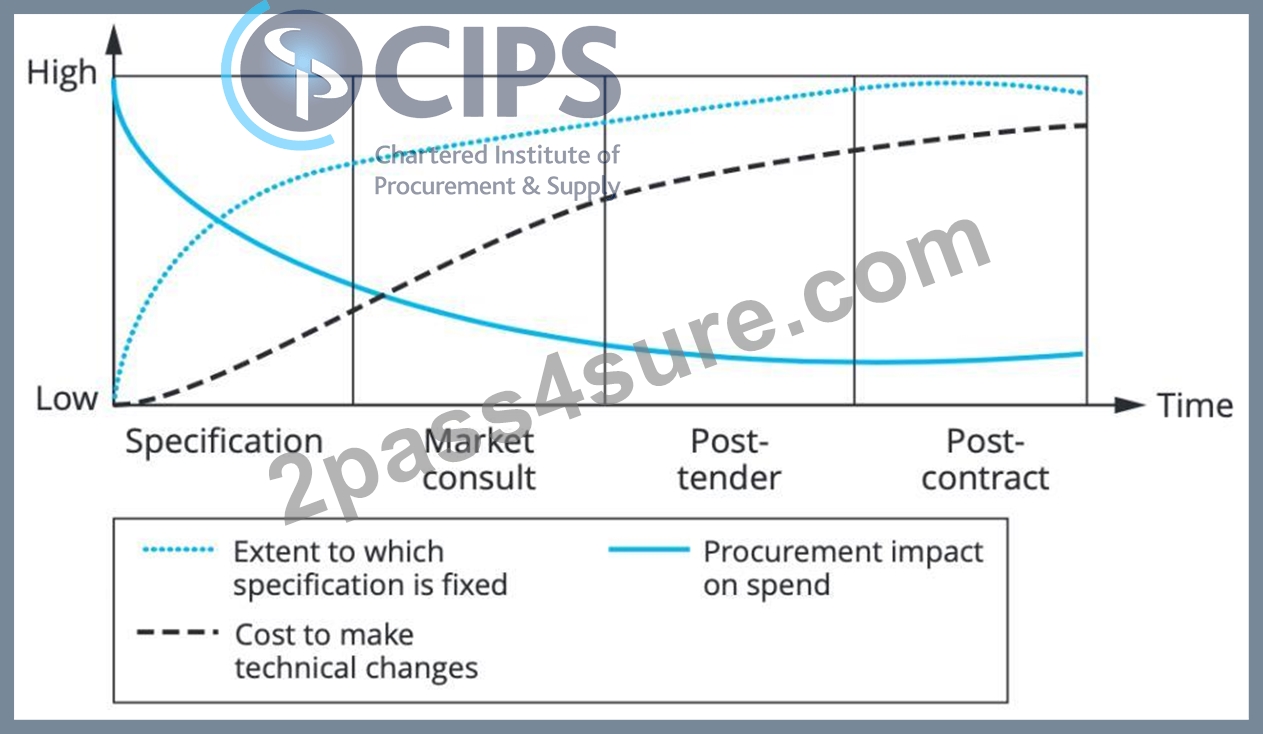
LO 2, AC 2.1
NEW QUESTION # 221
If a negotiation results in an offer which does not meet the buyer's minimum requirements, which of the following could the buyer pursue?
- A. BATNA
- B. PESTLE
- C. STEEPLE
- D. ZOPA
Answer: A
Explanation:
Explanation
Best alternative to a negotiatedagreement (BATNA) is the plan B or back-up plan in the event of a 'walk away'. In case of no deal, buyer (or supplier) may switch to this option.
The zone of potential agreement (ZOPA) is considered an area where two or more negotiating parties may find common ground. It is this area where parties will often compromise and strike a deal. In order for negotiating parties to find a settlement or reach an agreement, they must work towards a common goal and seek an area that incorporates at least some of each party's ideas.
STEEPLE offers an overview of various external fields. It is an acronym for Social, Technological, Economic, Environmental, Political, Legal and Ethical.
PESTLE is a mnemonic which in its expanded form denotes P for Political, E for Economic,S for Social, T for Technological, L for Legal and E for Environmental. It gives a bird's eye view of the whole environment from many different angles that one wants to check and keep a track of while contemplating on a certain idea/plan.
LO 1, AC 1.2
NEW QUESTION # 222
A procurement professional is preparing for a negotiation of purchasing non-critical commodity products. He knows that the product can be easily replaced by other substitutes in the market. The negotiation for these products is typified by which of the following?
- A. The approach must be collaborative
- B. There will be regular structured negotiations
- C. There will be only limited negotiation
- D. The buyer should focus on wider costs and risk elements
Answer: C
Explanation:
With non-critical commodity products, the relationship will be transactional. Buyer should not spend too much time and effort into the negotiation.
Table Description automatically generated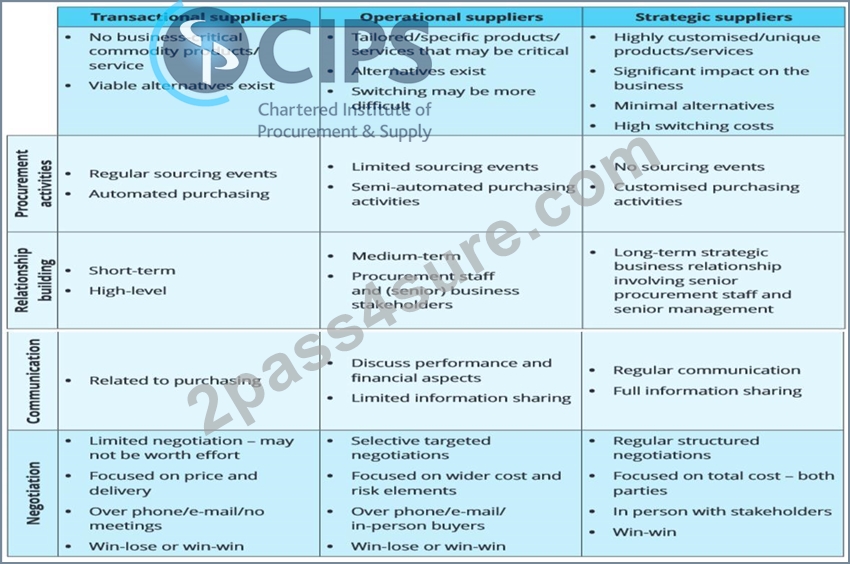
LO 1, AC 1.4
NEW QUESTION # 223
Which of the following are sources of legitimate (personal) power? Select THREE.
- A. Position power
- B. Assumed power
- C. Influenced power
- D. Coercive power
- E. Direct power
- F. Referent power
Answer: A,D,F
Explanation:
Legitimate power in negotiation can arise from different sources:
* Position power (authority from role/position in the organisation).
* Referent power (influence from respect, charisma, or relationships).
Reference: CIPS L4M5 (2nd ed.), LO 3.1 - Sources of power in negotiation.
NEW QUESTION # 224
Which of the following are most likely to beindirect costs of a garment manufacturer? Select THREE that apply.
- A. Textile
- B. Depreciation of machinery
- C. Maintenance materials
- D. Zips pads
- E. Utilities
- F. Packaging material
Answer: B,C,E
Explanation:
Indirect costs are those cost that are not directly attributable to production. Examples of indirect costs including the following:
Indirect labour: This covers every person in the factory who does not directly perform a production operation such as managers, supervisors, engineers, store personnel,clerks, maintenance staff, porters, canteen staff, security and cleaners etc.
Expenses: Included in this element is every fixed and variable expenses incurred in operating the factory, such as rent, rates, utilities, insurance, depreciation, maintenance, air conditioning and the various types of energy generation required by a clothing factory.
Indirect materials: Also known as consumables, this element contains all the materials not directly connected to the makeup of a garment. Some of the typical items involved are office materials, spare parts, marker paper, maintenance materials, chalk & pins.
Direct costs are those costs of a product/service directly attributable/traceable to its production. Examples of direct costs including the following:
Direct Materials: Direct materials are all the materials and trimmings which go into the construction and finish of the garment. Typically, these materials would include cloth, lining, fusible, zips pads, tapes, labels, tickets, hangers and packaging materials.
Direct Labour: This cover the cost of all the labor directly involved in producing the garment and could include cutting, fusing, regular sewing, special machine operations, pressing, finishing, inspection and packing. Labor of all types and grade has a directoverhead which include holiday pay, sick pay, fringe benefits etc and the statutory payments made by the employer for each employee. This is usually expressed as a percentage of salary and when this percentage is added to the employee's wage, it becomes the basis for calculating direct labor costs.
NEW QUESTION # 225
If the price of a good is above the equilibrium price, which of the following will happen?
- A. There is a surplus (i.e. an excess supply) and the price will rise
- B. The quantity demanded is equal to the quantity supplied and the price remains unchanged
- C. There is a shortage (i.e. an excess demand) and the price will fall
- D. There is a surplus (i.e. an excess supply) and the price will fall
Answer: D
Explanation:
:
In microeconomics, equilibrium price is determined when the quantity demanded is equal to the quantity supplied at equilibrium price in a market, there will be no shortages and no surpluses. If we combine our supply and demand curves on one graph, the point at which they converge determines the equilibrium price. If the price is set above this price and you read across the graph you will see the supply excess demand and there will be a surplus. In order to reduce this surplus, the price will need to fall. The scenario is illustrated in the graph below:
Chart, line chart Description automatically generated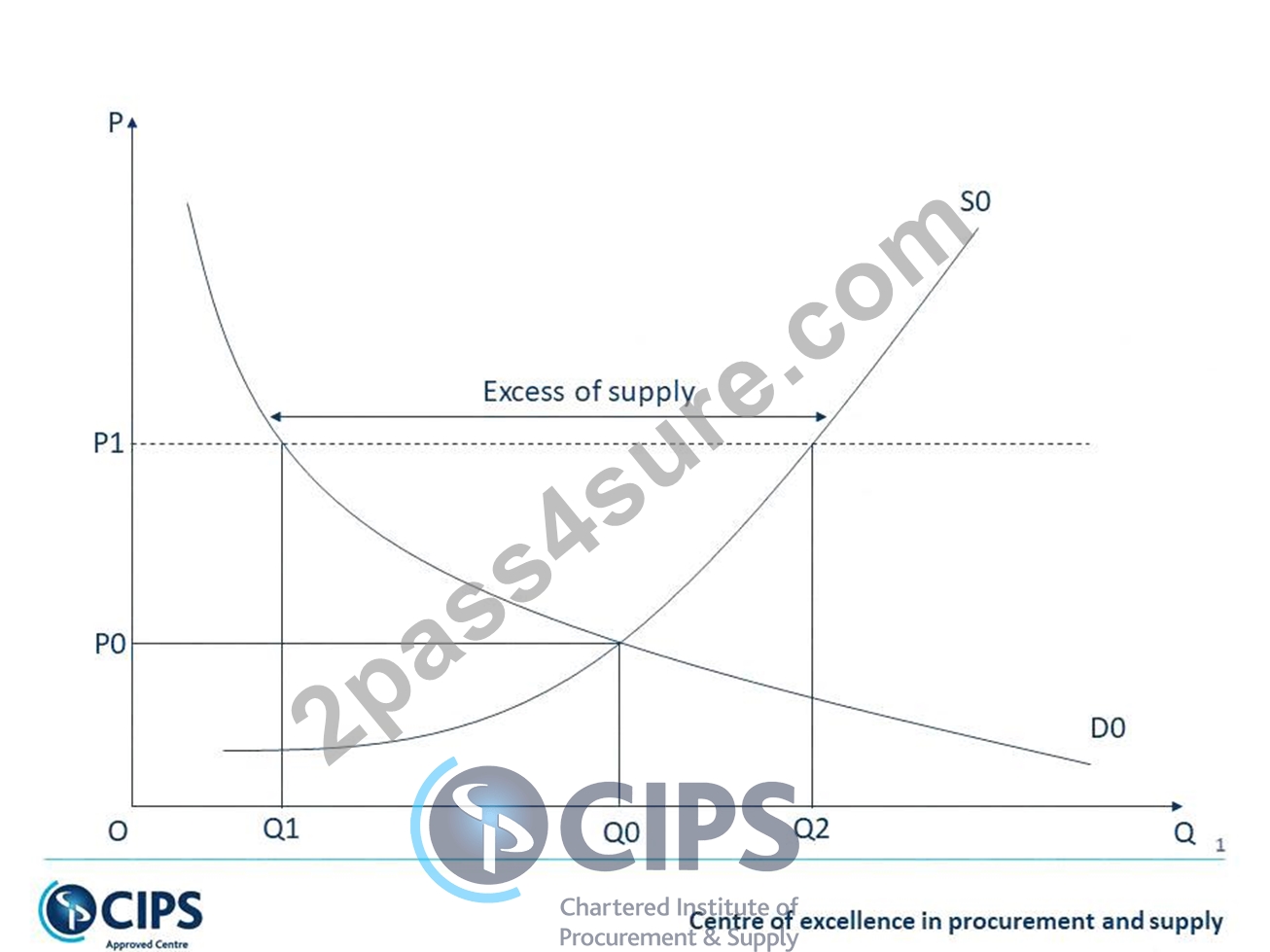
NEW QUESTION # 226
In which of the following persuasion methods, the influencer uses logics and objective reasons to persuade the others to buy into influencer's ideas?
- A. Directive (push)
- B. Collaborative (pull)
- C. Persuasive reasoning (push)
- D. Visionary (pull)
Answer: C
Explanation:
There are two major persuasion methods: 'push' and 'pull'.
Persuasion can be defined as encouraging someone to do something that you want them to do for you.
Persuasion is reasoning with someone so that they will believe or do something they might not otherwise do.
Persuasion can be considered as 'pushing' on TOP so that they can accept the change in attitude or behaviour as a result of your actions.
Influence is the ability to affect the manner of thinking of another. Influence can be considered as pulling on TOP so that you achieve the same result, but TOP feels they have changed their attitude or behaviour as a result of their reflection and thinking, and not your direct actions.
There are multiple variables to consider when choosing between 'push' and 'pull'. Professor Fiona Dent of Ashridge Business School proposes situations when each style might be most appropriate, breaking down push into 'directive' and 'reasoning' and 'pull' into 'collaborative' and 'visionary':
Table Description automatically generated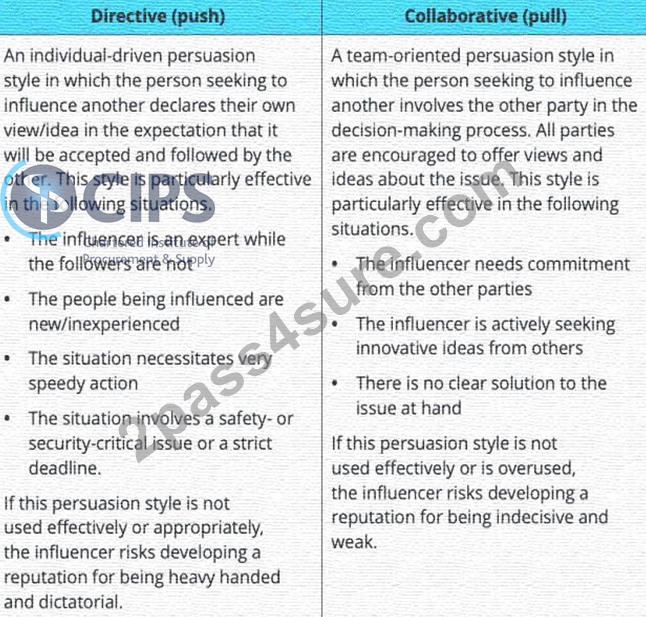
Text Description automatically generated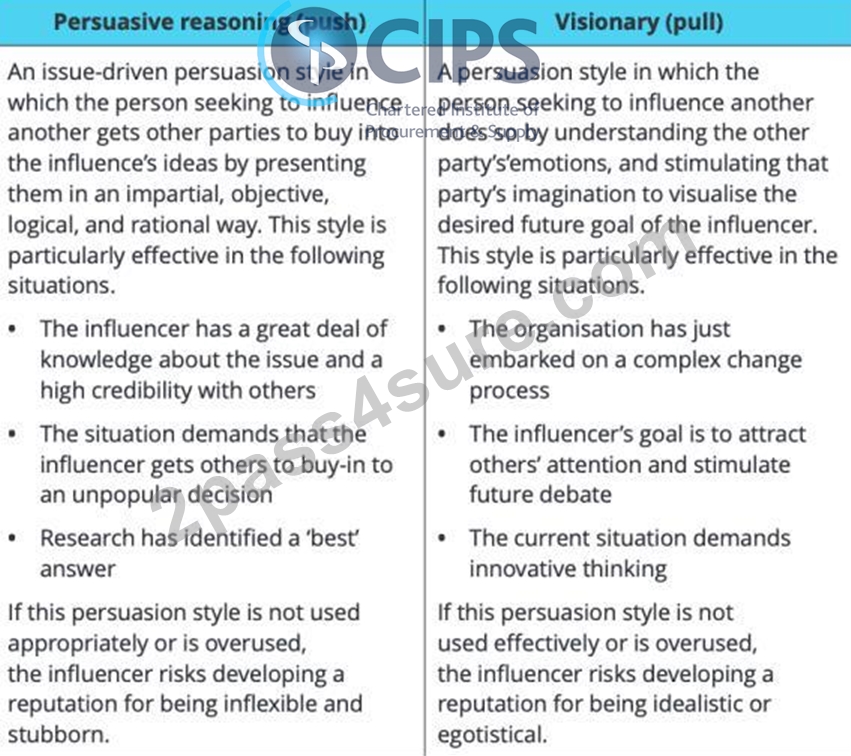
Using logical and objective reasons is one of the typical characteristics of persuasion reasoning method.
NEW QUESTION # 227
A purchasing manager is having a negotiation with a supplier to extend the duration of the contract. In order to persuade the supplier to cut the cost by 10%, she promises to shorten the payment period from
45 days to 30 days for each delivery. The supplier's representative does not agree the offer and clearly states that his proposed price is already lower than the market price. The purchasing manager has used which type of power?
- A. Expertise
- B. Coercive
- C. Reward
- D. Informational
Answer: C
Explanation:
:
In the scenario, to exchange cost cutting, the purchasing manager promises to 'reward' supplier shorter payment period. This is an example of reward power, which results from one person's ability to compensate or reward another for compliance.
The reward does not need to be money, but could be introduction to other buyers in the group, positive references, agreement to trial new product, quicker payment or indeed any other variable that the buyer knows is attractive and valued by the supplier.
NEW QUESTION # 228
Premium pricing strategies used by suppliers are characterised by which of the following? Select TWO that apply.
- A. Typically found in the early part of the product life cycle
- B. Price is based on cost structures
- C. This strategy is often used when supplier attempts to enter new market
- D. Premium price is determined by variable costs only
- E. Products are charged at a price based on supplier's reputation
Answer: A,E
Explanation:
There are several pricing strategies used by suppliers:
Cost-plus pricing - Total variable + Fixed cost + profit
Premium pricing - based on branding. Supplier determines to charge a very high price, notconnected with cost structures, usually based on its reputation and/or the perception that the product/service is of a superior quality. This strategy typically found in the early part of the product life cycle/when demand exceeds supply.
Penetration pricing - Supplier attempts to enter a new market or extend its share in an established one. It is characterised by price reductions to increase volume, followed by steady price increases; may even be loss leading at start (no profit made) Marginal cost pricing - covers only variable cost Market pricing - suppliers prices in line with what the market is willing to pay
NEW QUESTION # 229
Which of the following is a true statement regarding macroeconomic factors and their potential impact on negotiations?
- A. Macroeconomic factors cannot be influenced by anyone's expectation or sentiment
- B. Changes in macroeconomic factors may affect businesses and individuals differently
- C. Expectations on macroeconomic prospect are always correct
- D. Macroeconomic factors always directly influence the negotiations
Answer: B
Explanation:
'Macroeconomic factors always directly influence the negotiations': This statement is false. For any given negotiation it is not the macroeconomic factor itself that necessarily influences the negotiation but the change or rate of change that factor.
'Changes in macroeconomic factors may affect businesses and individuals differently': This statement is true.
Macroeconomic factors are factors that have general effects on the economy and many businesses may be completely unaffected or affected more or less than others in the same industry by a change in a factor.
'Macroeconomic factors cannot be influenced by anyone's expectation or sentiment': This statement is false.
When it comes to macroeconomic factors another key consideration is expectation regarding what might happen to these factors, or specifically the measures, metrics or percentage rates associated with these factors in the future.
'Expectations on macroeconomic prospect are always correct': This statement is false. Expectations are not always correct.
LO 2, AC 2.2
NEW QUESTION # 230
A garden furniture supplier who is currently in negotiations for a high-value contract has offered the procurement manager a visit to their site. The supplier suggests that during this visit, they can undertake the contract negotiation. What would be an appropriate response from the procurement manager?
- A. Decline the offer as it would take too much time to go and visit the supplier
- B. Accept the offer as this would be an ideal opportunity to see what the supplier can offer and will provide the supplier with familiarity while negotiating
- C. Accept the offer as this would save time; a supplier visit and negotiation could be done at the same time
- D. Decline the offer as negotiating while on a site visit will provide the supplier with an unfair advantage, as they will be in a familiar environment
Answer: D
Explanation:
Negotiating at the supplier's site can give the supplier a psychological advantage due to their familiarity with the setting. To ensure a neutral and balanced negotiation environment, it's preferable to conduct negotiations in a neutral location or through structured channels, as recommended in CIPS's guidance on negotiation settings.
NEW QUESTION # 231
Community Meal Partners (CMP) is a not-for-profit company that delivers cooked meals to older residents in their homes. CMP uses a fleet of bespoke vans with onboard ovens. In planning the future procurement of the fleet, CMP has conducted a review of the microeconomics of the van supply market and found that the vans are supplied by a monopoly supplier due to patented technology. Which of the following strategies could CMP utilise to optimise its bargaining position with the van supplier?
- A. Conduct regular and frequent tendering
- B. Procure shorter-term lease contracts
- C. Renegotiate van lease prices with the supplier
- D. Publicly seek alternative service solutions
Answer: D
Explanation:
When facing a monopoly supplier, buyers must find creative ways to introduce leverage. Publicly exploring alternative solutions can create the perception of competition or a fallback plan, thus shifting bargaining power slightly toward the buyer.
Reference: L4M5 Commercial Negotiation 2nd edition (CORE), Section 2.3 - Market Conditions and Negotiation Strategy
NEW QUESTION # 232
Which of the following are most likely to help buyer become preferred customer in supplier's perspective?
Select TWO that apply.
- A. Onerous supplier terms and conditions
- B. Reduction in delivery errors
- C. Shorter payment period
- D. Ensuring an increased number of repeat orders
- E. Compliance with agreed repair lead time
Answer: C,D
Explanation:
Explanation
Becoming a preferred customer to supplier's perspective can increase the purchaser's leverage in negotiation.
Beside the size of buying organisation or its spend, the following may be sufficient to differentiate the buyer from other buying organisations:
- Simple procurement processes
- Simple contracting processes
- Clear and concise documentation
- Absence of onerous supplier terms and conditions (onerous supplier terms and conditions mean that obligations imposed on suppliers are greater than their gains)
- On-time payment: The reduction in hassle for both supplier and the buyer, if bills are paid on time, is significant. From the customer's perspective it could also be the opener to agreeing preferential payment terms. A supplier may weigh up that payment on time at 60 days is worth taking, over the current 30-day terms that slip to 90 days and beyond.
-Transparent processes
- Ethical behavior
LO 1, AC 1.3
NEW QUESTION # 233
Jasmine and the IHL sales team have a negotiation scheduled with one of AB's lead buyers, Samuel, at AB's premises. This is one of the biggest negotiations that Jasmine has been involved in and is eager not to make any mistakes. Jasmine has heard from a colleague that Samuel tends to adopt an integrative negotiation style.
IHL senior management decides to send a team of three members to the negotiation. Jasmine is among the team and she is assigned to check body language, reactions, feeds insight to her leader and to record important comments and information from the meeting for minutes. Which of the following are roles of Jasmine in the forthcoming negotiation? Select TWO that apply.
- A. Secretary
(Correct) - B. Technical expert
- C. Commercial expert
- D. Chief negotiator
- E. Observer
Answer: A,E
Explanation:
:
A negotiating team can be as few as two people, and one person can play one or more of these roles:
Table Description automatically generated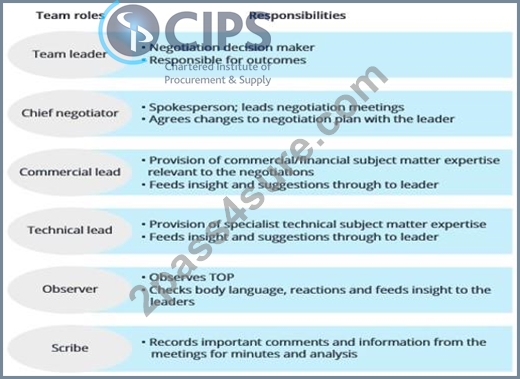
As from the scenario, Jasmine will act as an observer and a scribe (or secretary).
NEW QUESTION # 234
Ranjit is a facilities category buyer for a hospital in the UK and is managing an overseas sourcing project for security guard clothing and personal protective equipment. Ranjit is aware that foreign exchange fluctuations can create risk for his organisation and would like to remove this risk. Ranjit has asked the international suppliers to quote in GBP sterling. Will Ranjit's approach remove the fluctuation risk for the hospital?
- A. No, as the value of the supplier's currency may decrease
- B. Yes, as the risk will sit with the supplier
- C. No, as the risk will sit with the buyer as the value of GBP sterling may increase
Answer: B
NEW QUESTION # 235
According to Fiona Dent and Mike Brent, which of the following are characteristics of Push approach? Select TWO that apply.
- A. Seeking commitment
- B. Persuasion
- C. Inspirational
- D. Collaborative
- E. Directive
Answer: B,E
Explanation:
According to the book 'Influencing: Skills and techniques for business success' by Fiona Dent and Mike Brent, there are two major influencing styles. Push tends to be directive. It tells, and is clear and resolute, but needs to be employed in situations where firmness is required because of difficulties that exist or weakness is evident. Pull is more participatory and collaborative. It seeks to incorporate everyone's perspective. It can appear wishy-washy if not skilfully employed. Thatapproach should be followed which is most likely to secure commitment and not mere compliance.
The two divisions can be further divided into four style categories: directive; persuasive reasoning; collaborative - team oriented, people oriented to inspire them with a vision. The directive style relies on your expertise and reputation being respected by others, and where there really does seem to be one answer. It is
"I" driven whereas persuasive reasoning is more "we" and issue driven. Directive styles can make the user appear as "a bull in a china shop"; persuasive reasoning can be portrayed as tough guy.
Collaborative influencing takes the "we" element further and seeks to mobilise everyone's ideas in a journey of discovery. It may have the flavour of "I'm your best friend", which may not go down too well. Visioning style is concerned to stir people's emotions in support of achieving an objective. This last one has been used by demagogues to stir people's hearts and minds for evil purposes as well as good.
A useful table offers the benefits, problems, words and body language associated with each style along with advice on when to use and when to avoid each. Cases and exercises illustrate these styles.
Empathy comes in for extended treatment with the definition of "standing in the other's shoes". This does not necessarily happen just intuitively, and therefore before a specific influencing effort there should be an intense effort to think about the other person or persons and to sense what it might feel like to be them - their hopes, fears, concerns, what turns them on, what turns them off, where are they coming from.
Reference:
Influencing by Fiona Elsa Dent and Mike Brent, 2006 (bd-cons.com)
CIPS study guide page 163-165
NEW QUESTION # 236
Which of the following are recognised techniques in contract negotiation? Select THREE that apply.
- A. Pacing and leading
- B. Framing and reframing
- C. Anchoring
- D. Validation
- E. Ratification
- F. Role ethics
Answer: A,B,C
Explanation:
Explanation
The question asks about negotiation techniques which are not present in the book. In this question, there are only 3 recognised techniques:
- Framing and reframing: A frame is an assumption, or set of assumptions, that guides our attention and behavior. Reframing is the ability to identify and significantly change assumptions or perspectives. Framing has a significant impact on the effectiveness of negotiation outcomes and negotiator working relationships.
You can read more on framing and reframing here.
- Anchoring: Anchoring bias is well-known cognitive bias in negotiation and in other contexts. The anchoring bias describes the common tendency to give too much weight to the first number put forth in a discussion and then inadequately adjust from that starting point, or the "anchor." We even fixate on anchors when we know they are irrelevant to the discussion at hand. You can read more on anchoring here.
- Pacing and leading: Pacing and leading is a two-step lever of persuasion. First - You "match your pace" to the person you want to influence in as many ways as possible. You can do this by mimicking the way the person talks, stands, their appearance, etc. You can also mimic less tangible aspects like the way they act, or their emotional state.Second - Once you've set your pace with someone, lead them to whatever decision or behavior you want them to take! You can read more on pacing and leading here.
NEW QUESTION # 237
......
L4M5 Dumps PDF and Test Engine Exam Questions: https://certtree.2pass4sure.com/CIPS-Level-4-Diploma-in-Procurement-and-Supply/L4M5-actual-exam-braindumps.html